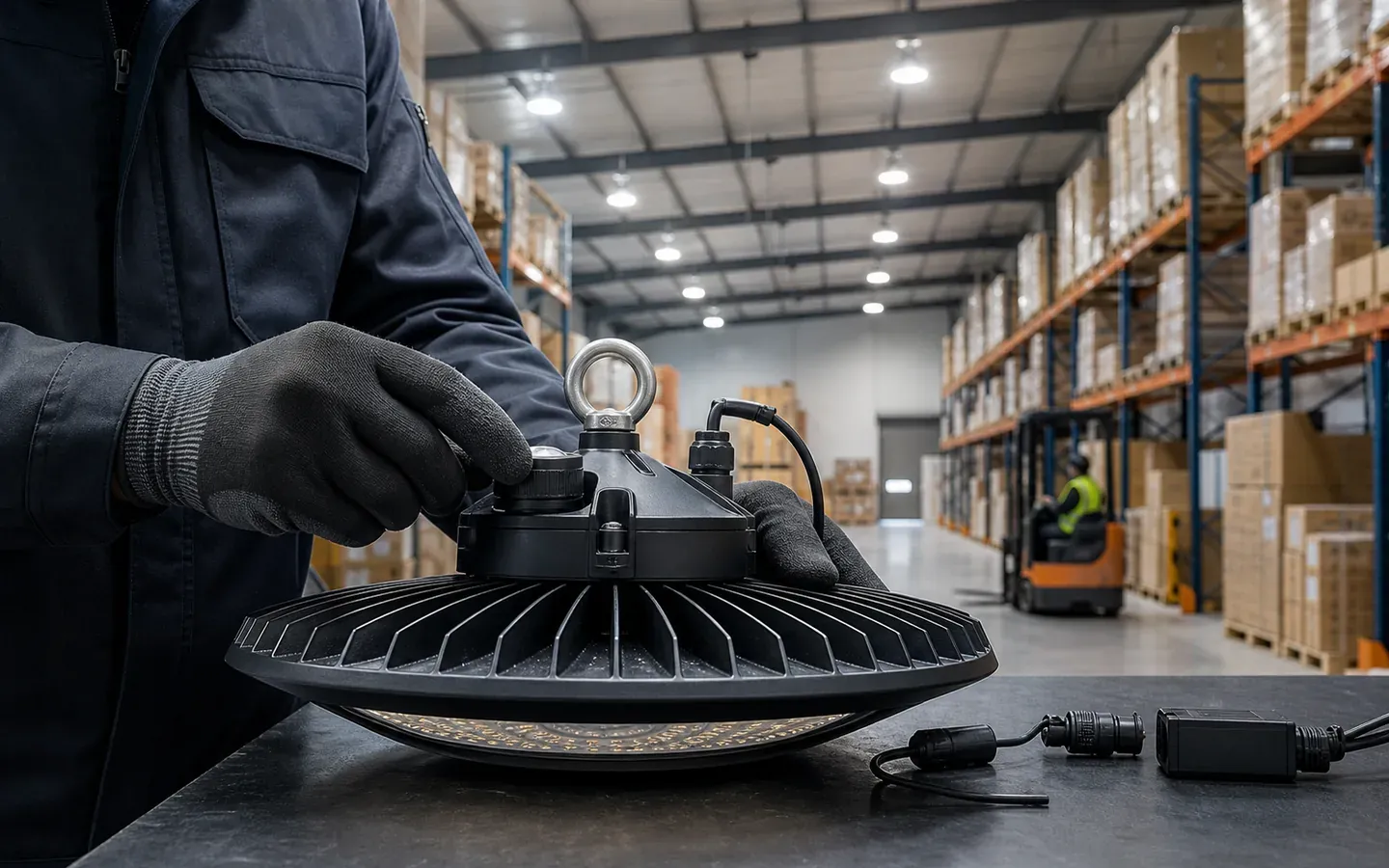
A sensor socket on a high bay does not automatically make the luminaire Zhaga-D4i certified. B2B buyers need to verify the interface, driver, node, power supply, certification status and commissioning responsibility as one system.
Buyer takeaway: define the required certification and data functions in the RFQ. “Zhaga-ready” and “D4i compatible” can describe different levels of evidence.
Know what Book 20 covers
Zhaga Book 20 defines an interface between an indoor LED luminaire and a sensing or communication node. The node can be installed and replaced in the field and connects to the driver/control system. Zhaga’s Book 20 overview describes the multi-supplier and upgrade benefits.
Certification is a controlled claim. Zhaga explains that products are tested through authorized test centers and listed in its database under the relevant certification process (Book 20 certification). Verify both the luminaire and node records where certification is specified.
Define the business case before choosing the socket
For a warehouse, potential functions include:
- occupancy detection and zone control;
- daylight response near rooflights;
- energy reporting;
- operating-hour and fault data;
- asset identification;
- future wireless-network migration.
Select only the functions the project will commission and maintain. Adding sockets without a controls plan increases cost but does not create savings.
Use the warehouse sensor-zoning guide to map control zones before choosing node coverage and mounting positions.
Verify the complete interface stack
Request a diagram that identifies:
| Layer | Evidence |
|---|---|
| Luminaire | Exact Book 20 certification/listing if required |
| LED driver | D4i identification and supported data features |
| Socket | Mechanical position, cap and ingress protection |
| Node | Certification, sensor/radio functions and power demand |
| Network | Gateway, protocol, cybersecurity and ownership |
| Software | Commissioning, licenses, export and update policy |
Check how many sockets are installed and whether they are top- or bottom-facing. The physical position affects sensor view, radio performance, contamination and accidental impact.
Protect environmental performance
Adding a receptacle creates an enclosure interface. Confirm the luminaire’s IP and mechanical ratings with the specified cap or node installed. Document what happens when a node is removed and whether a replacement cap is required.
In dusty or washdown areas, review cleaning chemicals, condensation and service access. A socketed high bay for a normal warehouse should not be assumed suitable for a food plant or corrosive process area.
Specify data, not just connectivity
D4i can support standardized luminaire, energy and diagnostics data, but buyers should state what the control platform must read and retain. Define asset ID, energy values, failure alerts, operating hours and driver data required at handover.
Confirm data ownership, retention, API/export options and offline behavior. Decide whether a warehouse can continue safe operation if the gateway or cloud service is unavailable.
Coordinate DALI and node commissioning
Zhaga-D4i addresses the intra-luminaire interface; it does not replace the project’s zone logic, sensor settings or acceptance testing. Document high-end trim, occupancy timeouts, daylight setpoints, grouping and failure states.
The DALI-2 versus 0–10V guide helps teams choose the wider control architecture. For retrofit projects, survey wiring and panel capacity before ordering UFO high bays or linear high bays.
Plan replacement over the warehouse life
Record approved node models, firmware, driver programming and socket caps. Test replacement without removing the luminaire. Ask how a new node is enrolled, whether settings follow the device or cloud record, and how failed devices are decommissioned securely.
Future flexibility depends on clean documentation, not the connector alone. Include a spare-node ratio, credential handover and administrator training in the commercial scope.
RFQ wording example
“Provide Book 20 Zhaga-D4i luminaires and nodes where scheduled. Submit database records for exact models, D4i driver details, interface drawing, environmental rating with node/cap installed, supported data fields and network architecture. Include commissioning, offline behavior, credential handover, firmware policy, replacement procedure and five-year compatible-node plan.”
This turns a smart-high-bay claim into a testable package that operations teams can support after the installer leaves.