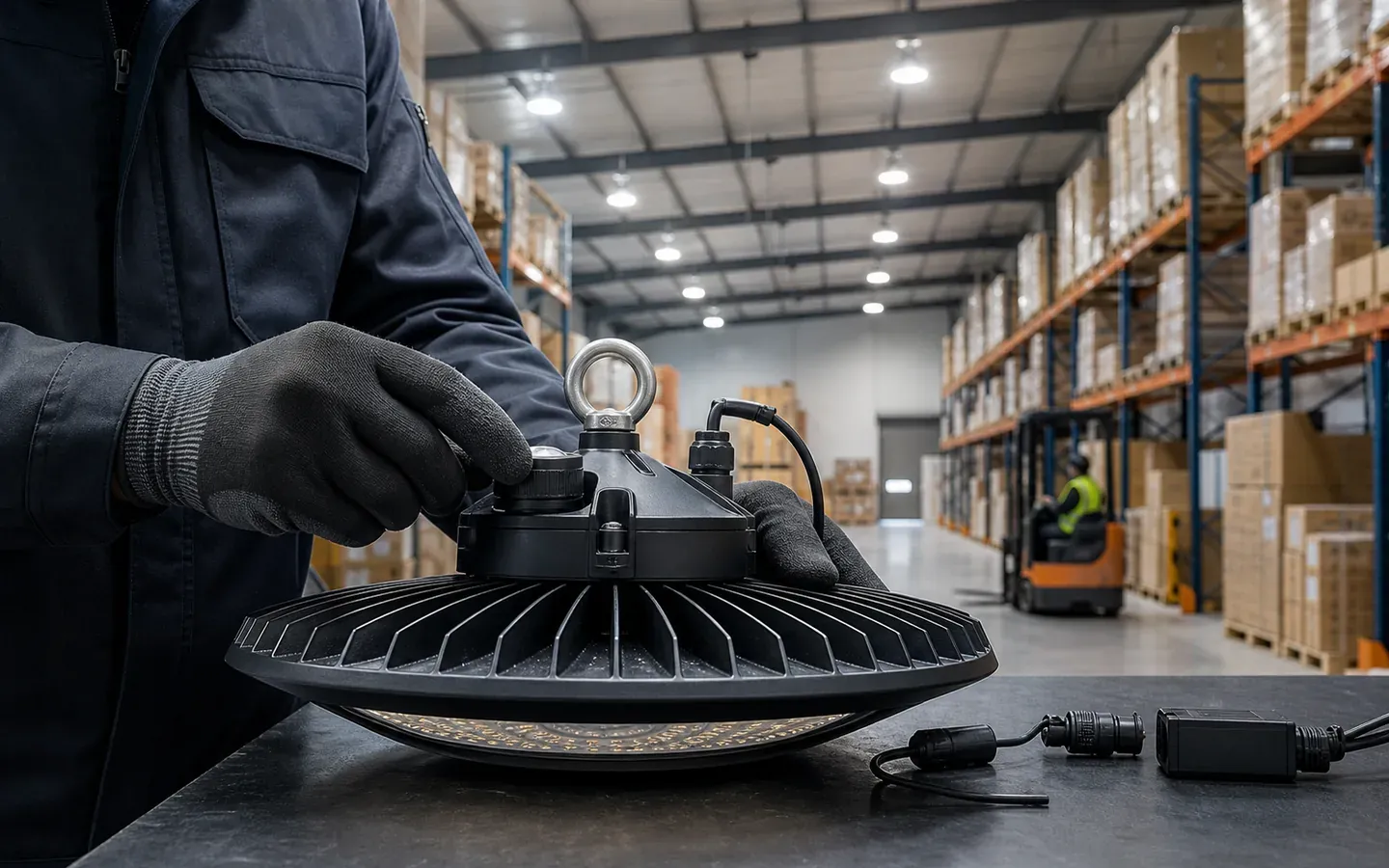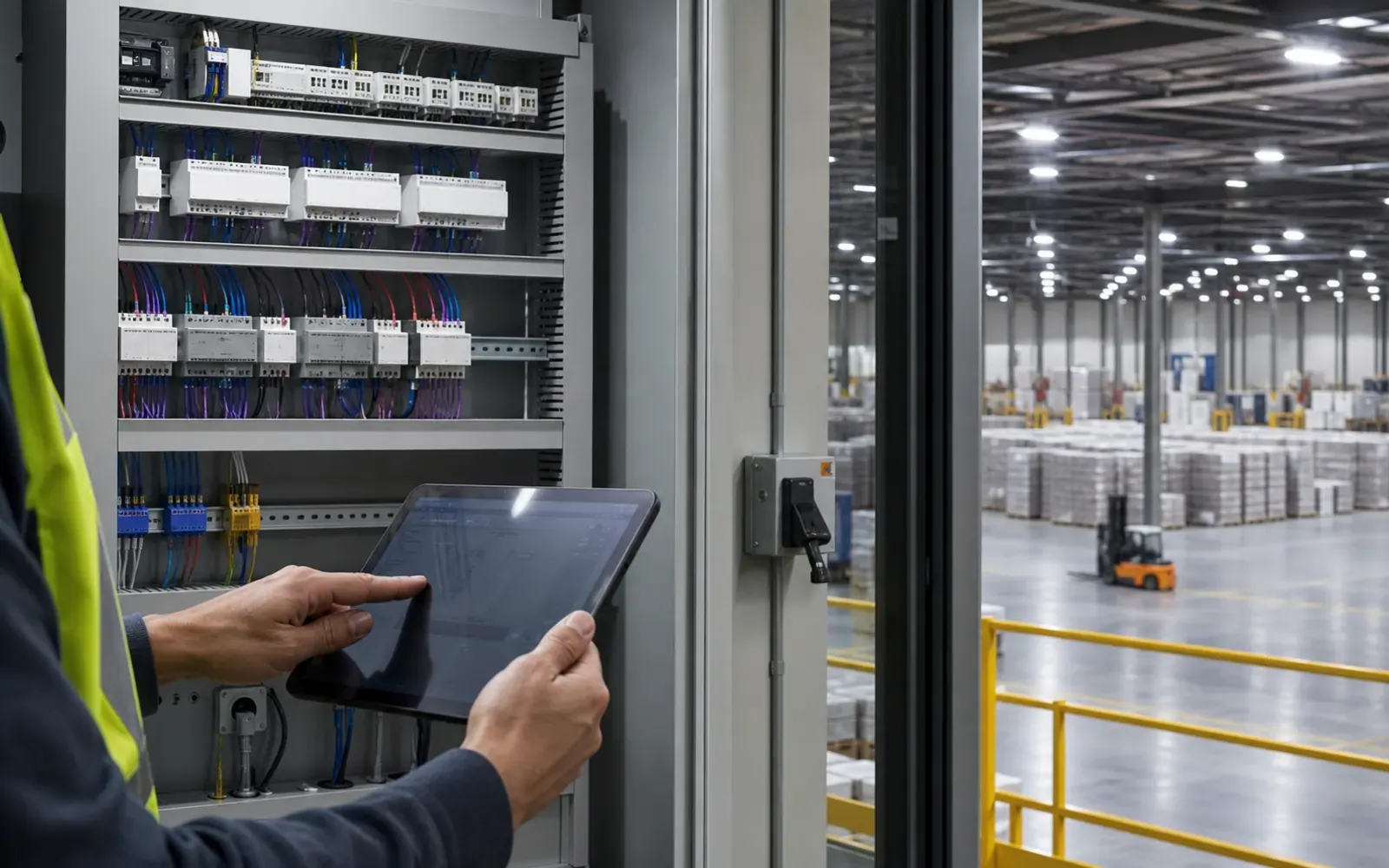
Warehouse controls underperform when every high bay receives the same sensor setting. Rack aisles, open staging, packing stations, docks and rooflight zones have different occupancy patterns and daylight exposure, so the control design should follow space use rather than a fixture count.
Buyer takeaway: issue a zone schedule with the lighting RFQ. Sensor type, coverage, grouping, timeout and minimum output should be commissioned for each operational area.
Survey the warehouse before selecting sensors
Record mounting height, rack height, aisle width, rooflights, clerestories, HVAC movement, doors, conveyors and expected material-handling routes. Note whether forklifts, people or both must trigger the light.
Sensor datasheets often show idealized coverage on an open floor. Racks and stored goods block views; fans and warm air can affect some detection technologies. Require a coverage drawing at the real mounting height and orientation.
Build zones around operations
Useful zone types include:
- individual narrow aisles or short aisle groups;
- cross aisles and intersections;
- open bulk-storage areas;
- receiving and dispatch docks;
- packing, inspection and workstation areas;
- rooflight/daylight bands;
- emergency and continuous-operation routes.
Avoid grouping a busy cross aisle with rarely used rack aisles. The busy traffic will hold the whole group at full output and erase expected savings.
Separate occupancy and daylight logic
Occupancy control responds to use; daylight control trims electric light when natural light is sufficient. A rooflight zone may need both. Define which signal has priority and how they interact at night, during cloudy periods and when the space is unoccupied.
U.S. Department of Energy guidance recommends considering occupancy sensing, task tuning and dimming when daylight is present for commercial and industrial LED luminaires (DOE purchasing guidance).
Choose open-loop or closed-loop daylight sensing
An open-loop sensor measures incoming daylight without directly seeing the controlled electric light. A closed-loop sensor measures the combined light in the space. Each needs correct placement, field of view and commissioning.
Prevent the sensor from seeing a bright rooflight patch, luminaire aperture, reflective package or moving door that does not represent the task plane. Use a deadband and fade time that avoids visible hunting under passing clouds.
| Setting | Commissioning question |
|---|---|
| High-end trim | What output meets the maintained design target? |
| Occupied level | Is the task safely lit without defaulting to 100%? |
| Unoccupied level | Off or low level, and for how long? |
| Timeout | Does it fit real traffic frequency? |
| Fade time | Is the transition acceptable to workers and cameras? |
| Daylight setpoint | Was it calibrated at the representative task plane? |
Select the high-bay distribution first
Controls cannot correct a poor optical layout. Use linear high bays where rectangular distribution suits rack aisles and consider UFO high bays for open areas after calculation. The UFO-versus-linear comparison provides a procurement framework.
Then match the sensor mounting and lens to that layout. An integral sensor is convenient, but a remote sensor may see an aisle or doorway more reliably.
Coordinate protocol and commissioning ownership
0–10V can provide simple grouped dimming; DALI-2 can support addressed devices and feedback; wireless or Zhaga-D4i nodes can reduce control wiring. Compare architectures in the DALI-2 versus 0–10V guide.
Whichever system is selected, name the party responsible for sensor aiming, grouping, setpoints, software credentials, testing and operator training. Controls supplied but never commissioned are not a complete system.
Verify with trend data and a walk test
Commission during representative daylight and operating periods. Walk and drive the actual routes; load racks where practical. Check response at aisle ends, intersections and behind tall stock. Record false-off and false-on events.
Use trend logs to review occupancy, dimming and energy behavior after several weeks. Adjust by zone and keep a version-controlled settings export for recovery.
RFQ clause
“Submit a warehouse control-zone plan based on final racks, rooflights and traffic routes. For every zone, state sensor technology, mounting, coverage, grouping, occupied/unoccupied levels, timeout, fade, daylight method, failure state and commissioning procedure. Include final settings export, administrator credentials, training and post-occupancy tuning.”
This turns a generic “sensor-ready high bay” into a measurable control outcome with a clear handover.