LM-79, LM-80 and TM-21 are frequently bundled together in quotations, but they do not test the same object or prove the same claim. A B2B buyer can avoid misleading lifetime comparisons by matching each document to the question it actually answers.
In one line: LM-79 measures a complete lighting product’s performance; LM-80 measures lumen maintenance of LED packages, arrays or modules; TM-21 projects long-term lumen maintenance from LM-80 data.
What LM-79 tells you
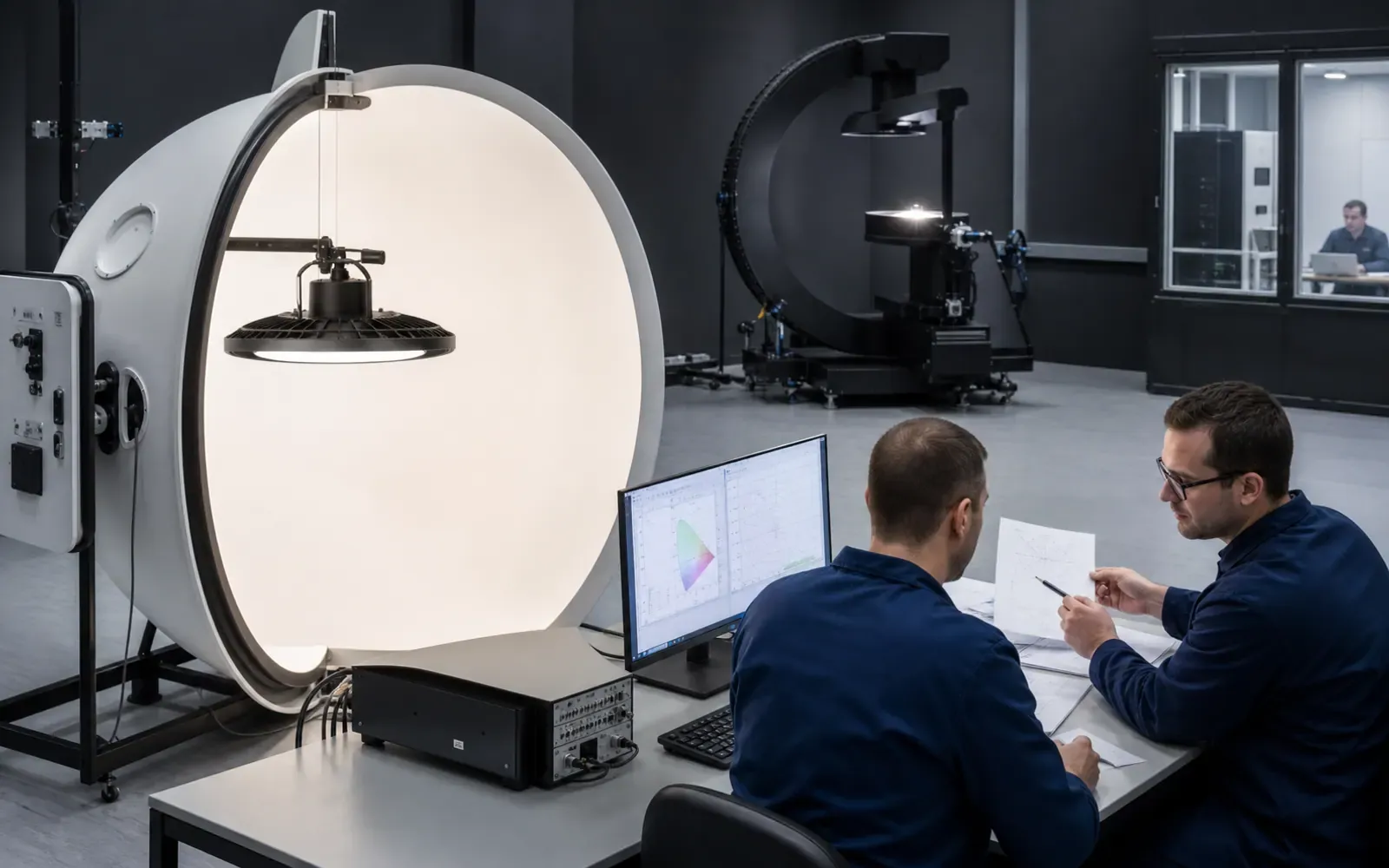
An LM-79 report is used for photometric and electrical measurements of a complete solid-state lighting product. Depending on the report, relevant outputs can include total luminous flux, input power, efficacy, color characteristics and intensity distribution.
For procurement, verify:
- manufacturer and model code;
- rated input voltage and frequency;
- CCT, CRI and optical option;
- driver and power setting;
- report date, laboratory and accreditation scope;
- IES/LDT file consistency with the report;
- tolerance between report and production specification.
A report for a 150 W, 5000 K, 90° version does not automatically validate a 200 W, 4000 K, aisle-optic version.
What LM-80 tells you
LM-80 evaluates lumen maintenance of LED sources over time at controlled temperatures and drive conditions. It is not a test of the complete high bay, driver, seal, connector or thermal design.
Check whether the LED package in the report matches the product bill of materials. Review the tested case temperatures, drive currents, chromaticity data and duration. The luminaire’s in-situ LED temperature should remain within the conditions used for a defensible projection.
What TM-21 tells you
TM-21 provides a method to project lumen maintenance from LM-80 data. A projected L70 value indicates when light output is expected to reach 70% of initial output under stated conditions. It is not a complete-luminaire failure rate and does not predict driver, gasket, connector, coating or sensor life.
Avoid turning a long TM-21 projection into a blanket warranty statement. Ask for the reported projection limit, temperature and drive-current basis.
| Document | Test object | Useful buyer question | Does not establish |
|---|---|---|---|
| LM-79 | Complete lamp or luminaire | Does this configuration deliver the claimed light and power? | Long-term system reliability |
| LM-80 | LED package/array/module | How does the LED source maintain output under test conditions? | Driver or luminaire life |
| TM-21 | Projection using LM-80 data | What lumen-maintenance projection follows from the data? | Warranty duration or failure rate |
UL lists photometry, lifetime/lumen maintenance and environmental testing among its lighting performance capabilities (UL lighting performance). Use an accredited laboratory’s scope and report identifiers as part of supplier verification.
Build a claim-to-evidence matrix
For every key claim, name the evidence required:
- lumens, watts, efficacy, CCT and CRI: complete-product photometric report;
- distribution: IES/LDT file from the tested optic;
- LED lumen maintenance: LM-80 plus a valid TM-21 projection;
- rated ambient: thermal evaluation of the complete configuration;
- IP/IK: relevant environmental/mechanical test report;
- surge: model-specific surge test conditions;
- safety: certificate or listing for the target market;
- control compatibility: system test with the offered driver and sensor.
This matrix turns a brochure review into a traceable quality process.
Check for substitution risk
Industrial lighting supply chains change. Put critical components into the approved specification and require notification before substitutions. At minimum, control the LED package, driver, SPD, lens, gasket and sensor. Ask how a proposed alternative will be requalified.
During pre-shipment inspection, compare nameplates, internal part numbers where permitted, photometric spot checks and approved sample construction. Keep one golden sample and the signed data package.
Questions to ask a supplier
- Which exact SKU was tested?
- Is the laboratory accredited for the stated method?
- Does the IES file originate from that configuration?
- Which LED package and drive current are used in production?
- What in-situ temperature supports the TM-21 projection?
- Which failure modes are covered by the warranty?
- What component changes require buyer approval?
Use these questions with our industrial lighting RFQ checklist. When comparing a high bay or modular floodlight, score evidence quality separately from price so an incomplete report set is visible in the commercial decision.