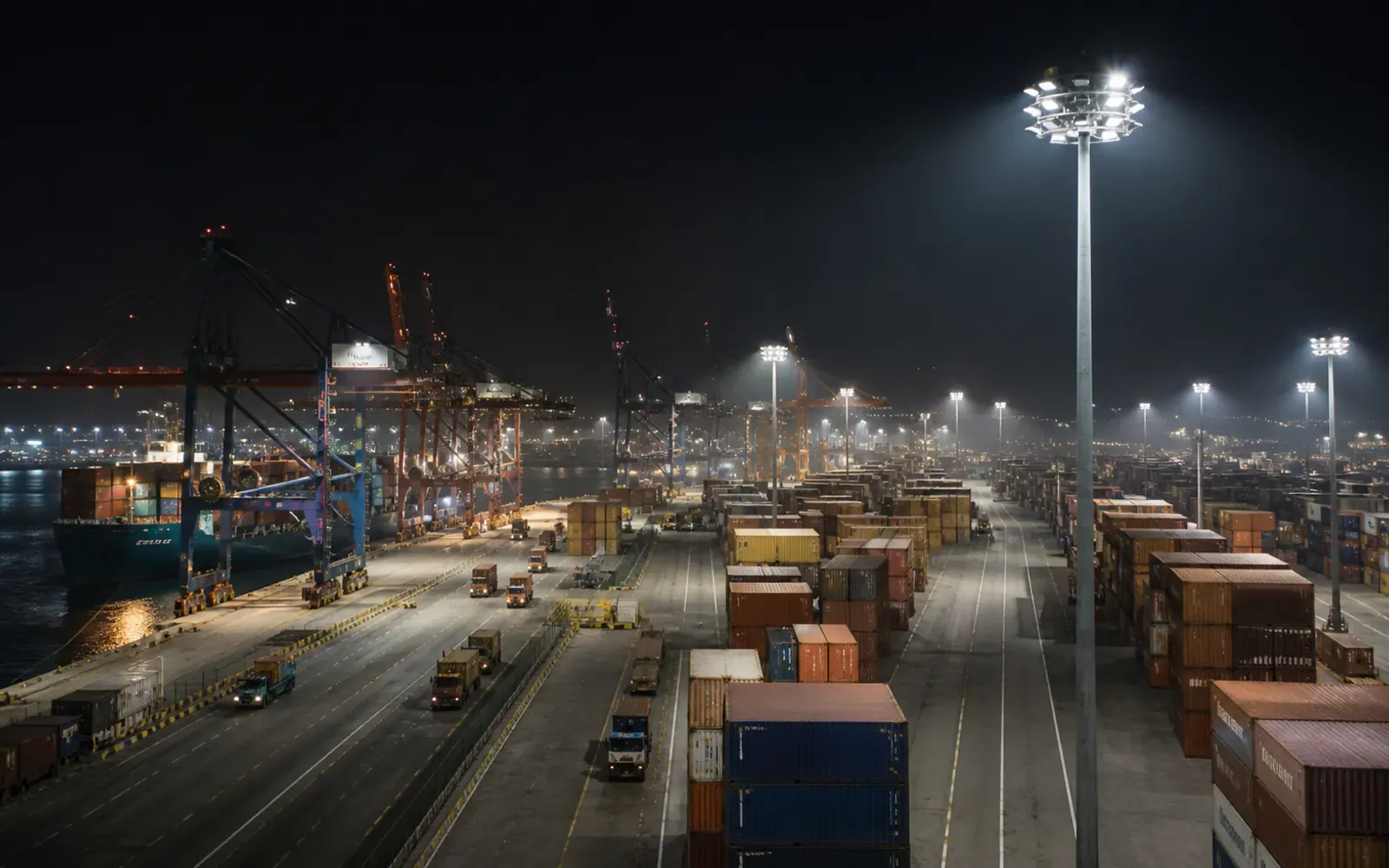
Port lighting combines long throw distances, moving equipment, salt-laden air, electrical transients and expensive high-mast maintenance. The lowest fixture price is rarely the lowest lifecycle cost if optics, coating or service access are wrong.
B2B priority: submit the yard geometry, crane routes, coastal exposure and electrical distribution together. Photometric and environmental choices are linked.
Map operational tasks and obstructions
Separate container stacks, vehicle lanes, rail transfer, quay edges, gates, inspection zones and maintenance areas. Record stack heights and expected changes. A calculation based on an empty yard can overstate performance once containers block light.
Define horizontal and vertical task planes. Crane and reach-stacker operators need visibility of container faces, twist locks, markings and pedestrians, not just average lux on the pavement.
Select optics by throw and mounting position
High-mast layouts often mix narrow, medium and asymmetric distributions. Narrow optics serve distant targets but require precise aiming; asymmetric optics can improve perimeter layouts and reduce backlight. Model the exact IES/LDT files.
Use the floodlight beam-angle guide to compare peak intensity, field shape and spill rather than relying on a nominal degree label.
Specify the coastal environment
Provide distance from the shore, airborne salinity, prevailing wind, industrial pollutants, wash method and expected maintenance interval. Request details for coating system, pre-treatment, thickness, fasteners, brackets, cable glands, connectors and dissimilar-metal isolation.
A salt-spray test can support comparison, but hours in a cabinet do not directly equal years on site. Review the test method, scribe condition, acceptance criteria and whether the sampled construction matches production.
Design for water and pressure changes
Large sealed housings heat and cool, creating pressure cycles that can stress gaskets. Confirm pressure-management design, drainage, mounting orientation and cable-entry sealing. IP evidence should apply to the complete offered assembly.
Use captive hardware and a service method that prevents dropped components. A modular LED floodlight can allow driver or optical-module service, but the replacement procedure must be practical on the installed mast.
Coordinate surge protection
Remote poles and long feeders can increase transient exposure. Ask the electrical designer to coordinate service, panel and luminaire protection. Review earthing, conductor routing and end-of-life behavior of the SPD.
The LED luminaire surge-protection guide lists the test details a buyer should request. A single kV number without mode, waveform and current is incomplete.
Protect operators from glare
Check viewpoints from crane cabins, gatehouses, road approaches and ground vehicles. High-intensity sources near the line of sight can reduce visibility even while raising measured lux. Add shields or louvers only after modeling their effect on useful light and wind area.
Control scenes can reduce output in inactive areas, but maintain safe routes and security coverage. Document failure states and manual overrides.
Check vibration and mechanical interfaces
High masts, crane structures and coastal wind expose brackets and connectors to repeated movement. Provide the mounting substrate, bolt pattern and vibration environment. Verify bracket locking, secondary retention, cable strain relief and connector support. A laboratory housing test does not validate an improvised field bracket.
Plan high-mast maintenance
Calculate the cost of lowering systems, lifts, road closures and marine access. Require replaceable parts, connector cycles, corrosion-safe fasteners and a spares plan. Record driver, optic and SPD codes in the asset register.
For procurement comparison, include:
| Evidence | Why it matters |
|---|---|
| Project photometric file | Confirms light reaches real task planes |
| Coating and corrosion test data | Supports coastal material selection |
| IP/IK evidence | Validates sealing and impact resistance |
| Surge test details | Connects fixture protection to site exposure |
| Thermal report | Checks high-output operation at ambient |
| Service instructions | Reveals actual high-mast maintenance time |
Commission under operating conditions
Verify aiming after poles settle, then measure representative task and boundary points. Repeat checks with typical container stacks if possible. Test control scenes, loss of communication and power restoration. Photograph and record final aiming.
A complete port RFQ should combine the industrial lighting project checklist with site corrosion, surge and maintenance schedules. That gives suppliers a common basis for a defensible technical and commercial offer.