The practical difference between a UFO and a linear LED high bay is not the housing shape. It is how well the luminaire’s intensity pattern matches the floor and rack geometry. For B2B buyers, the right comparison is therefore vertical illuminance, uniformity and installed cost, not watts or lumens alone.
Short answer: use a linear high bay with an aisle optic where tall racks create long, narrow corridors. A UFO LED high bay is usually more economical above open storage, staging and production areas. Mixed warehouses often need both.
Start with the warehouse geometry
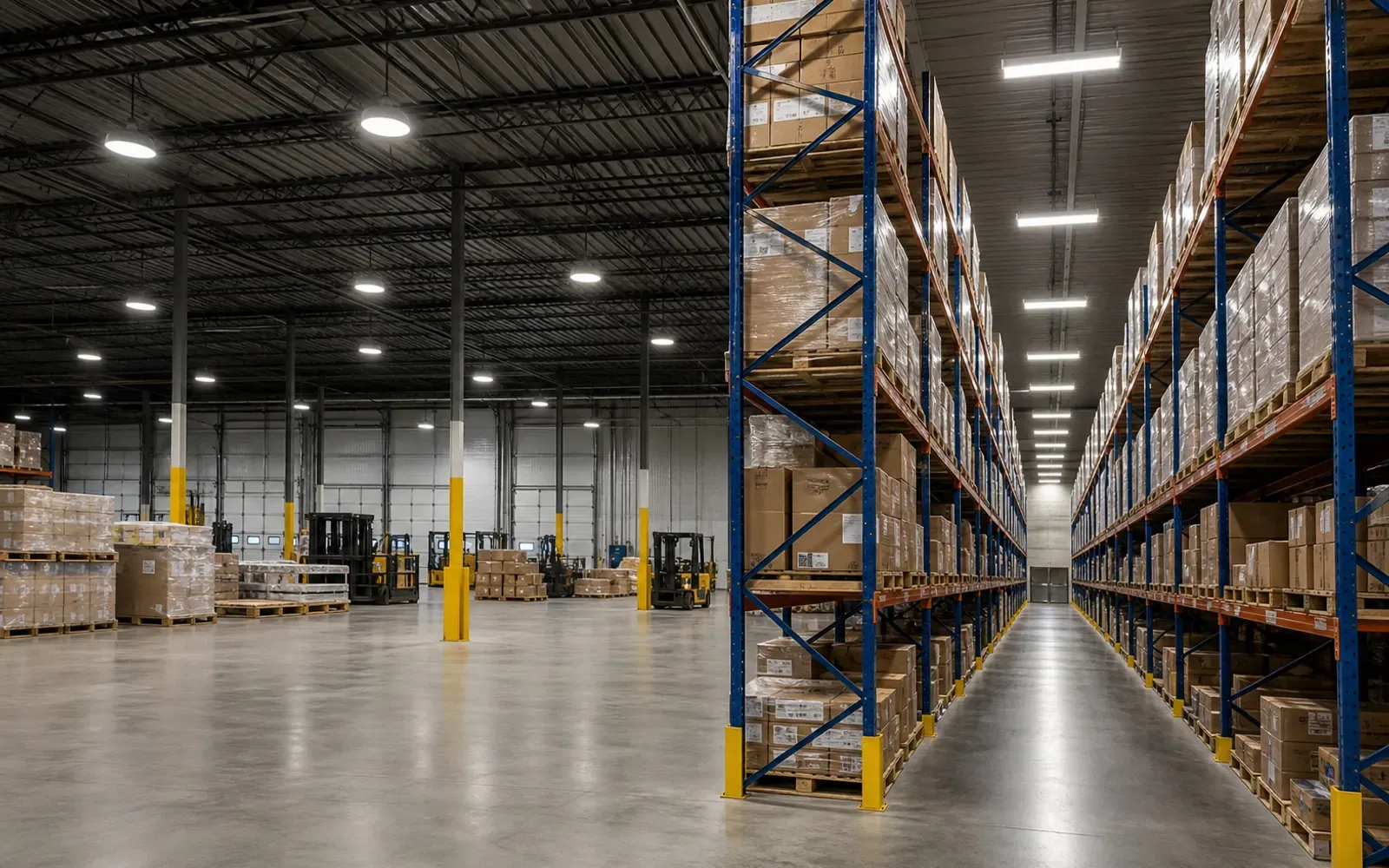
Record the mounting height, aisle width, rack height, rack orientation and allowed fixture positions. A round symmetric distribution can place too much light on rack tops and too little on labels at eye level. An elongated aisle optic redistributes that output along the aisle and onto vertical faces.
Do not choose an optic from beam angle alone. Ask for an IES or LDT file and model it in the actual layout. Our warehouse high bay specification guide explains the inputs needed for a credible calculation.
| Decision point | UFO high bay | Linear high bay |
|---|---|---|
| Best-fit area | Open floor, bulk storage, workshops | Narrow racks, pick aisles, assembly lines |
| Typical distribution | Symmetric 60°, 90° or 120° | Rectangular or asymmetric aisle pattern |
| Mounting | One hook or pendant point | Two suspension points or surface bracket |
| Visual comfort | Reflector or diffuser may be needed | Larger luminous area can reduce source brightness |
| Layout flexibility | Easy to relocate | Better alignment with fixed rows |
Compare vertical lux, not only floor lux
Horizontal illuminance helps people move safely, but pickers read labels and locate stock on vertical surfaces. Add vertical calculation planes at representative rack faces, especially at the lowest and highest pick levels. Evaluate minimum values and uniformity, not only the average.
A supplier can make almost any layout reach an average target by adding output. That does not prove the light is in the useful place. Require a false-color plot, calculation grid, maintenance factor and luminaire aiming/orientation in the submission.
Check glare at realistic viewing angles
Forklift operators often look forward and upward. A compact high-output source can enter the field of view even when floor lux is acceptable. Compare lens diffusion, reflector depth, shielding and mounting position. If glare is a concern, ask for UGR information where the method is applicable and review the rendered calculation from driver eye level.
Calculate installed cost by zone
Fixture price alone can reverse the conclusion. Include:
- fixture quantity after photometric design;
- suspension hardware and additional mounting points;
- wiring or plug-and-play leads;
- lift time and aisle closures;
- sensor quantity and commissioning;
- expected cleaning and driver access.
A linear fixture may cost more per unit but need fewer units in a long aisle. A UFO may win in open areas because it installs from a single point. Compare complete zone totals on one drawing.
Use controls that understand aisle movement
High-bay occupancy sensors must be rated for the mounting height. Confirm detection pattern at the installed height, forklift approach direction, hold time, standby level and fade time. A sensor that sees across adjacent aisles can keep an empty row on; one with a narrow detection zone can miss cross-aisle entry.
For projects needing addressable groups, diagnostics or future reconfiguration, compare DALI-2 and 0–10V high-bay controls. The U.S. Department of Energy notes that commercial and industrial LED luminaires can work with occupancy sensing, task tuning and dimming, but the control sequence still has to suit the site (DOE acquisition guidance).
What to put in the RFQ
Specify the layout rather than naming a preferred housing:
- CAD or dimensioned plan with rack positions.
- Mounting height and available suspension points.
- Horizontal and vertical illuminance targets.
- Required uniformity and maintenance factor.
- Maximum connected load for the zone.
- Control protocol, sensor height and operating sequence.
- IES/LDT files and a calculation report with assumptions.
Ask the supplier to submit one optimized option and one lower-capital-cost option. This exposes the trade-off between fixture count, light quality and future flexibility.
Acceptance checks before a bulk order
Model the proposed photometric file, test a sample at operating voltage, inspect glare from the forklift route and confirm the mounting kit against the roof structure. For a large rollout, a mock-up aisle is more valuable than comparing products on a desk.
The final choice may be a hybrid: linear high bays for rack corridors and UFO fixtures for receiving, packing and open storage. That is not an inconsistent specification; it is an application-led one.