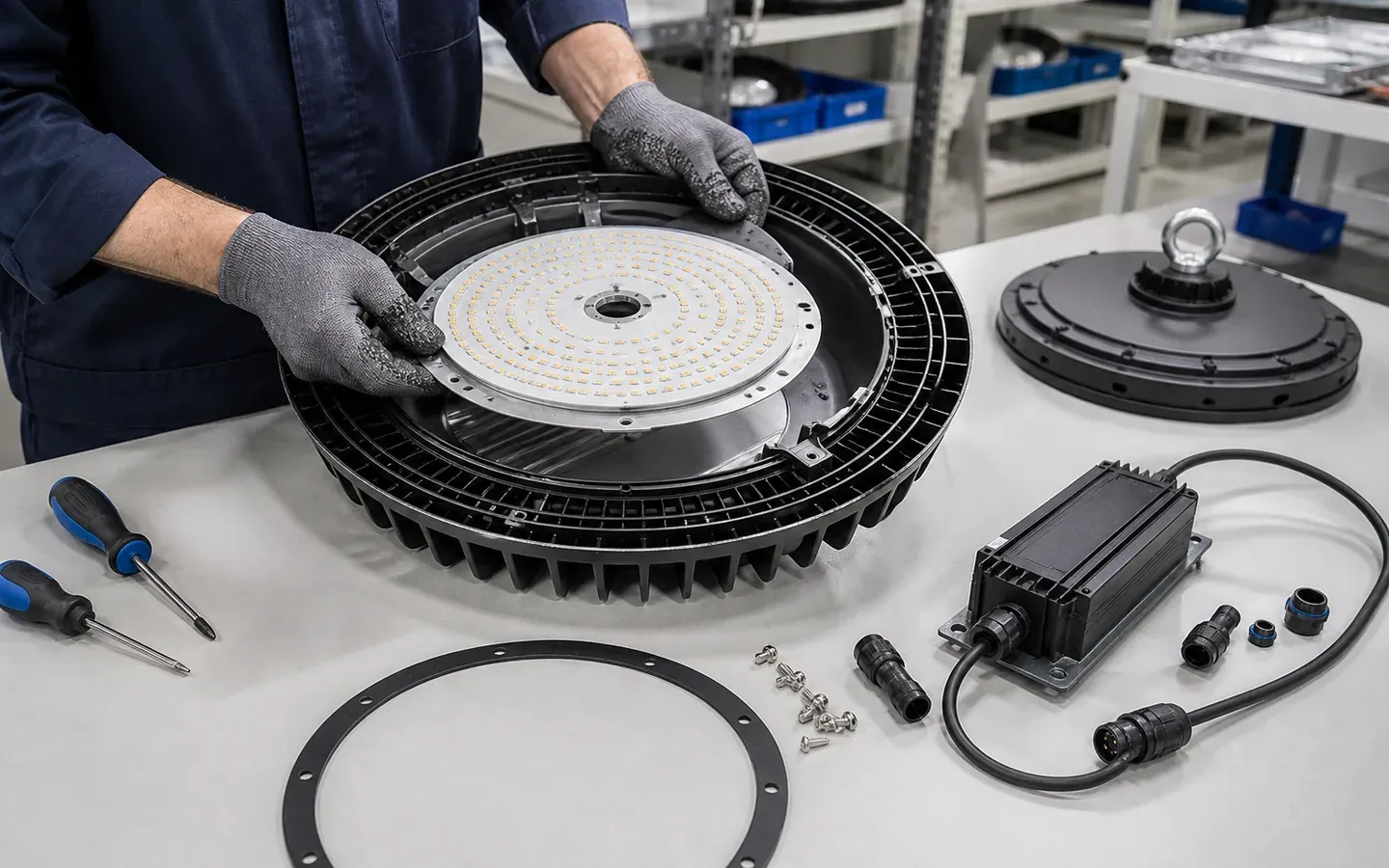
For an EU-bound industrial luminaire, “replaceable driver” is more than a service claim. Ecodesign rules distinguish light sources, separate control gear and containing products, and require specific information about whether parts can be replaced by an end user or a qualified person.
Buyer takeaway: request a model-specific replaceability statement, removal instructions and parts plan. A photo of an open housing does not prove compliant documentation or practical field service.
Identify what the product is under the regulation
The European Commission explains that ecodesign requirements for light sources and separate control gears apply under Regulation (EU) 2019/2020. It also notes that some luminaires can meet the definition of a light source, while many disassemblable luminaires are treated as containing products (European Commission lighting overview).
Classification affects testing, information and energy-labelling obligations. The energy label for luminaires as a general category was discontinued, but contained light sources or products treated as light sources may still have duties. Do not apply an old luminaire energy label by habit.
Read Article 4 as a design and documentation task
The regulation states that manufacturers, importers or authorized representatives of containing products should ensure light sources and separate control gears can be replaced using commonly available tools without permanent damage, unless a functionality-based technical justification is provided. It also requires information on who can perform replacement and how components can be removed for verification (Regulation (EU) 2019/2020).
That creates four procurement questions:
- Is the light source replaceable?
- Is the control gear replaceable?
- Is replacement intended for the end user or a qualified person?
- Where are the method and any technical justification documented?
Verify practical replacement, not theoretical access
An industrial luminaire may need tools, safe isolation, gasket replacement, torque control and post-service sealing checks. Ask the supplier to demonstrate the process on the exact model.
Record:
- access steps and tool list;
- connector type and polarity control;
- replacement driver electrical settings;
- thermal-interface material and application method;
- gasket inspection or replacement rule;
- fastener torque;
- earth-continuity check;
- functional and sealing verification after service.
If servicing compromises an IP rating, the instructions should say how integrity is restored. For food plants, combine the service review with the washdown high-bay checklist.
Make replacement parts identifiable
“Equivalent driver” is not a controlled spare. The replacement must match output current, voltage window, power, insulation, dimming protocol, thermal limit, surge coordination and mechanical fit. A programmable driver also needs a protected parameter file and version record.
Create a service parts table:
| Part | Identification to retain | Service evidence |
|---|---|---|
| LED module | Board code, CCT, flux/color bin | Replacement compatibility statement |
| Driver | Manufacturer code and programming | Electrical and thermal settings |
| Gasket | Material, profile and revision | Inspection/replacement instruction |
| SPD | Model and end-of-life behavior | Wiring and coordination record |
| Sensor/node | Interface and firmware | Commissioning procedure |
The surge-protection guide explains why a driver or SPD substitution cannot be judged by wattage alone.
Connect repairability to product change control
Replacement planning is only credible if the supplier controls revisions. Require notice when LED boards, drivers, connectors, optics or sealing parts change. Confirm whether the change affects declarations, reports, photometric files or service instructions.
For OEM buyers, add replaceability evidence to the private-label approval checklist. Store the approved parts list with the golden sample and technical file.
Consider standardized interfaces where useful
Standardized component and sensor interfaces can reduce dependence on a single part, but a logo or socket alone does not guarantee that every replacement will preserve luminaire performance. The next step is to define electrical data, programming, mechanical constraints and qualified service procedures.
For connected high bays, see the Zhaga-D4i procurement guide. For control-system selection, compare DALI-2 and 0–10V.
RFQ clause
“For each EU-bound model, state whether the light source and separate control gear are replaceable, by whom, and with which commonly available tools. Submit removal and replacement instructions, any functionality-based justification for non-replaceability, spare-part identifiers, post-service safety checks and sealing-restoration steps. Notify the buyer before changing service-critical components.”
Regulatory interpretation depends on the product and current law. The EU importer should review the final classification and documentation with a qualified compliance specialist.