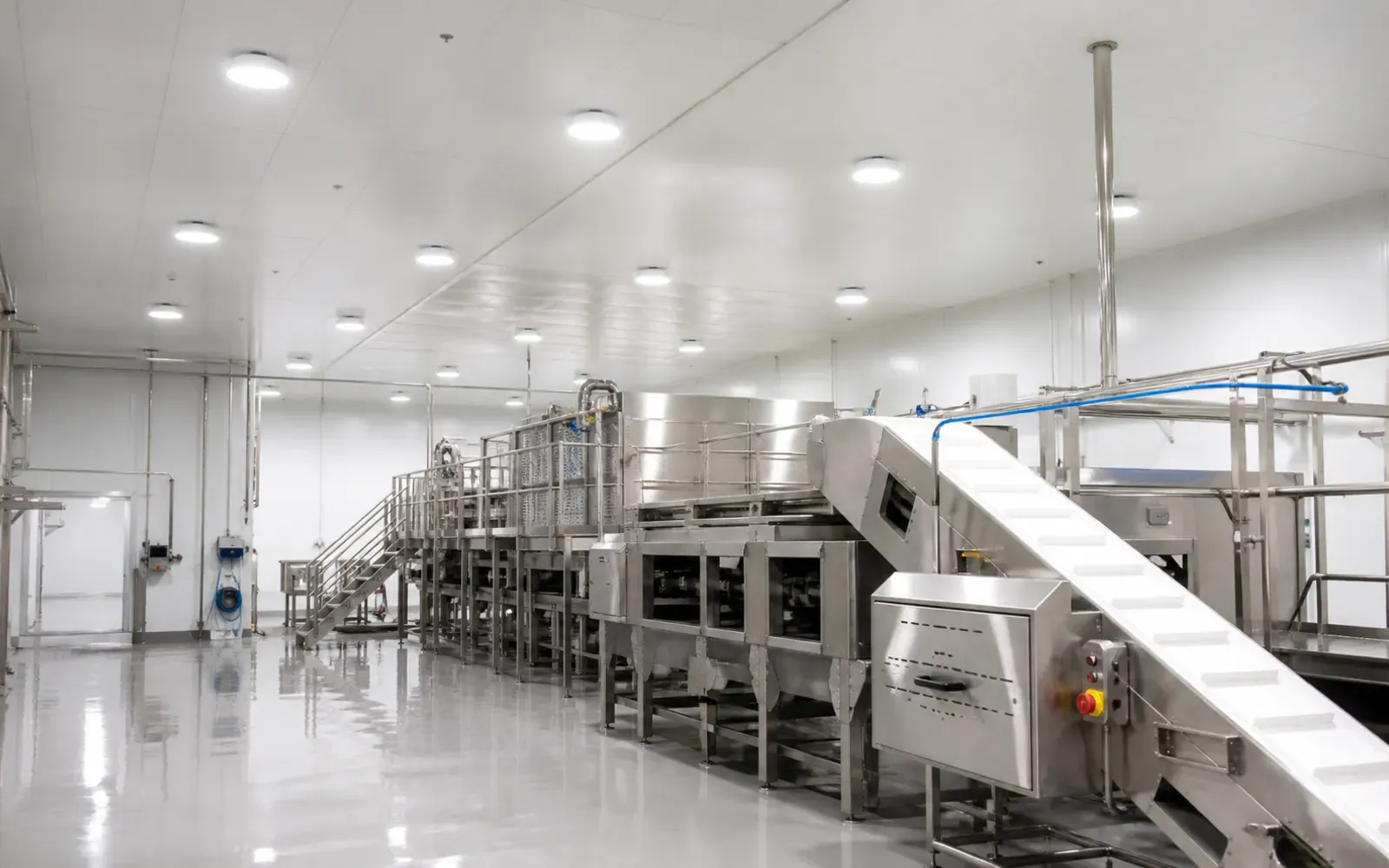
Food-plant lighting is a contamination-control and maintenance problem as much as a photometric one. A suitable high bay should be cleanable, sealed for the actual wash process, resistant to site chemicals and designed so damaged parts cannot fall into product zones.
Short answer: define the hygiene zone, wash pressure, chemicals, temperature and breakage policy before choosing an IP rating. IP69-style marketing alone does not establish food-contact suitability or cleanability.
Classify the area before specifying a fixture
Separate dry packaging, open product, high-care processing, cold rooms, washdown areas and external loading. Record whether luminaires sit above exposed food, enclosed conveyors or circulation routes. The consequence of a broken lens is different in each zone.
Consult the plant’s food-safety team. Their approved materials, cleaning agents and foreign-material policy should appear in the lighting schedule.
Cleanable construction matters
Favor smooth housings with minimal horizontal ledges, exposed threads or dirt traps. Check how the bracket, safety cable and electrical entry will be cleaned. A sealed optical chamber is useful only if the outside geometry can also be maintained.
Ask for material details rather than “food-grade” as a general claim:
- lens material and impact behavior;
- gasket composition;
- housing coating;
- fastener grade;
- cable jacket and gland material;
- resistance to the named detergents and sanitizers.
Match ingress protection to the wash process
IP ratings describe standardized dust and water tests, not every combination of hot water, pressure, nozzle distance and chemicals. Give the manufacturer the cleaning procedure. Confirm whether the test applies to the same cable gland, mounting orientation and accessory set being supplied.
Ingress protection can be one part of a qualification plan. Independent laboratories also evaluate moisture, rain, corrosion, chemical exposure and mechanical impact (UL performance testing overview).
Address breakage and impact
Where foreign material could reach product, specify a shatter-resistant lens or suitable containment method. Confirm impact rating for the complete luminaire and check that repeated cleaning does not embrittle the lens. A wire guard may protect against large impact but can also create a cleaning trap; review it with hygiene staff.
Document a damaged-luminaire response: stop line, isolate the area, account for fragments, replace the unit and release production through the site’s established procedure.
Design the light for inspection tasks
General floor lux is not enough for checking color, surface defects, labels or fill levels. Define task planes and required color quality. Ask whether high CRI is needed for a specific inspection rather than defaulting every zone to the same value.
Control glare on stainless steel and wet surfaces. Larger luminous areas, diffused optics and thoughtful positioning can be more effective than simply reducing wattage. Use an IES/LDT model and conduct a production-line mock-up where visual inspection is critical.
Drivers, flicker and rotating machinery
Processing lines can include rotating or reciprocating equipment. Request flicker data at full output and at every dimmed operating level. Confirm compatibility between the driver and proposed control. Cameras and machine-vision systems may need their own test using the actual frame rate and exposure settings.
The sports-lighting flicker guide explains the same measurement principle in a more demanding camera environment.
Build a traceable B2B submittal
Require a model-specific package:
- complete ordering code and bill of configuration;
- safety certification for the target market;
- IP/IK and chemical-resistance evidence;
- photometric file and LM-79 report;
- material declarations for exposed components;
- cleaning and maintenance instructions;
- warranty with ambient and chemical exclusions;
- change-notification agreement for driver, LED, gasket or lens substitutions.
UL distinguishes certification of a complete end product from recognition of components used inside it (UL lighting standards). Procurement should verify the mark and model at the luminaire level required by the project.
Pilot before a site-wide order
Install samples in the harshest representative zone. Run normal cleaning cycles, inspect for water entry and residue, check gasket compression and measure light after the trial. Ask operators whether glare affects inspection. Record the exact sample configuration so the production order cannot silently change.
Use the industrial lighting RFQ checklist for commercial inputs, then append the hygiene-zone and cleaning requirements above. TMG can configure industrial high bay lighting for a project review, but final acceptance criteria should come from the facility’s food-safety and electrical teams.