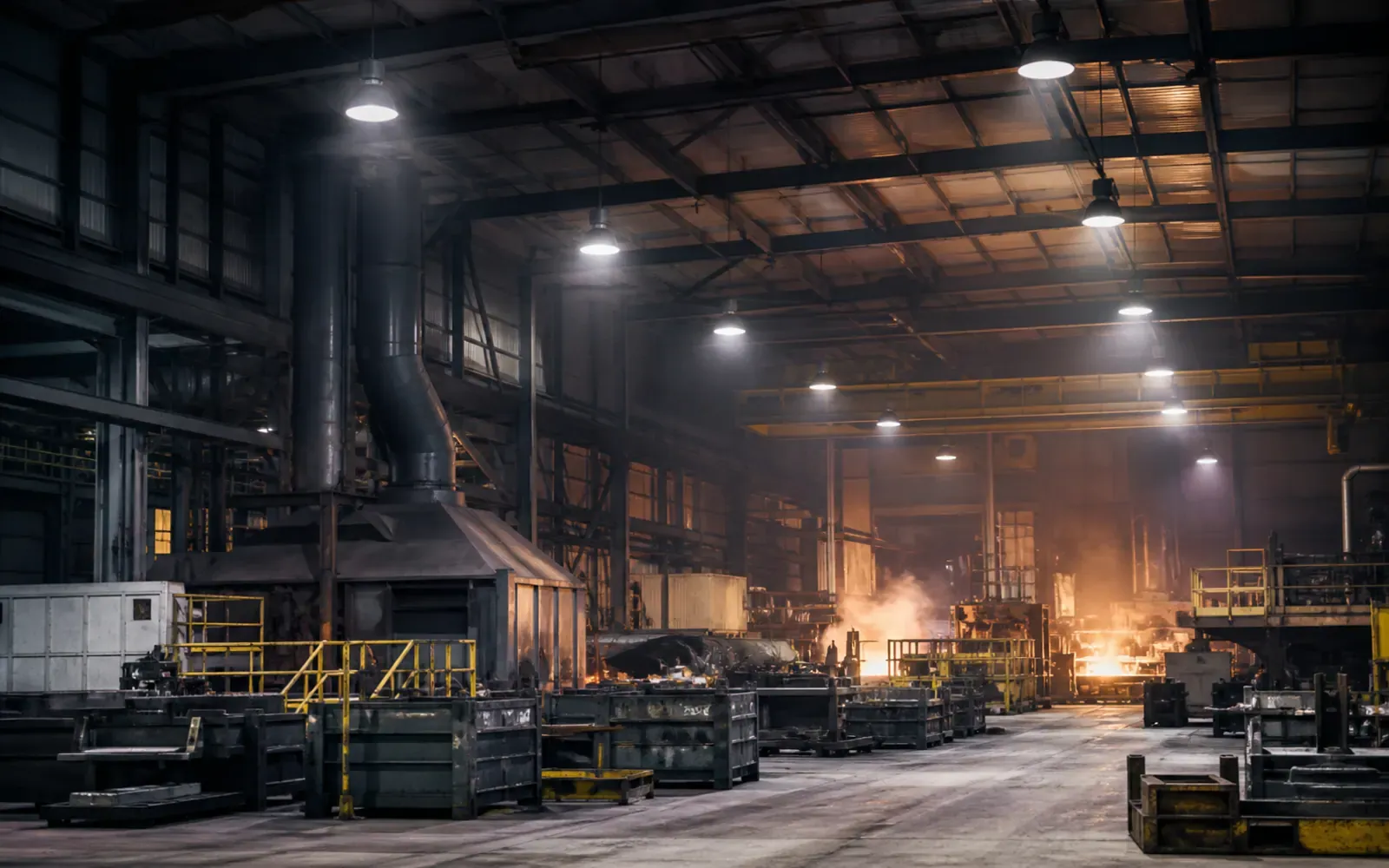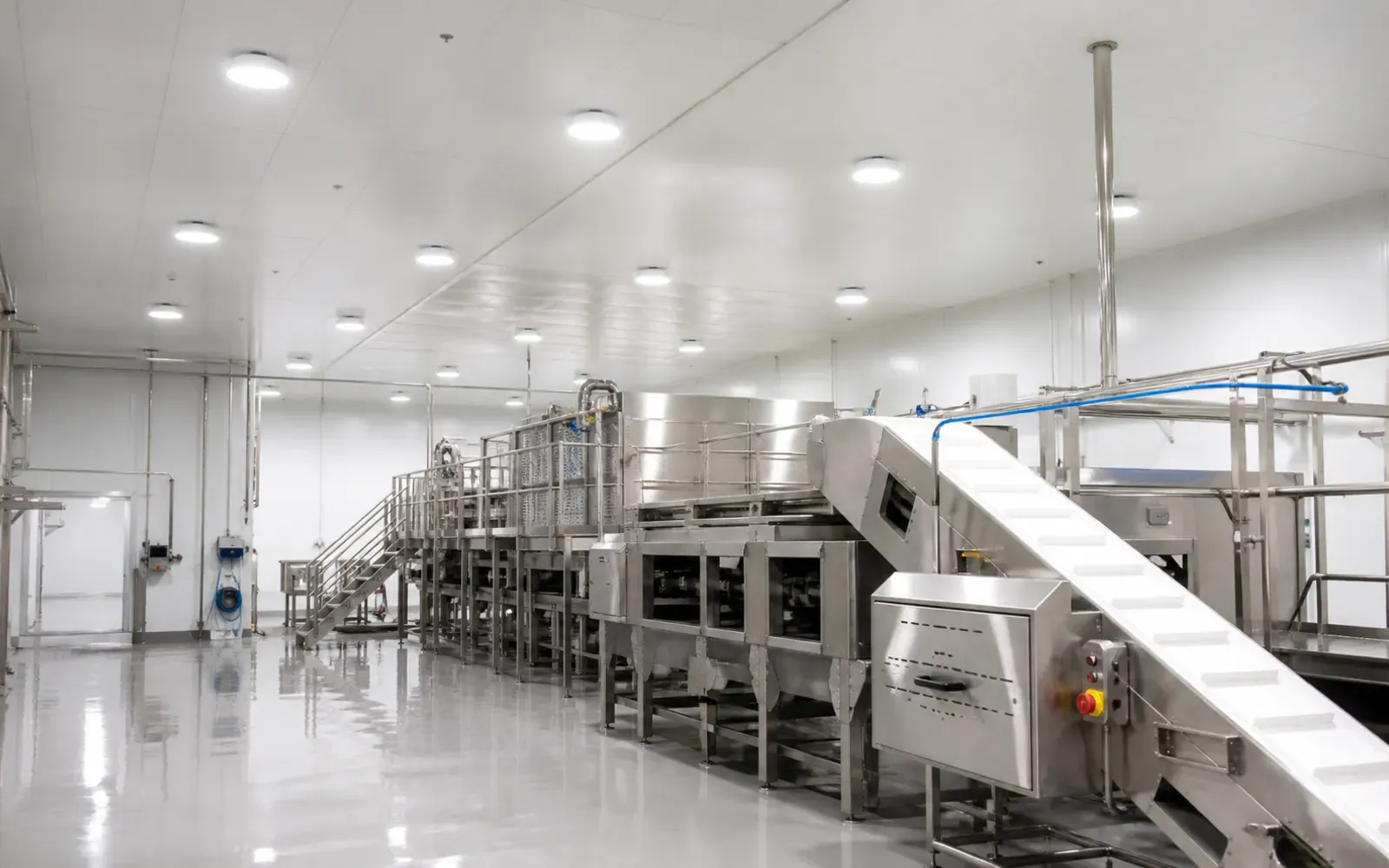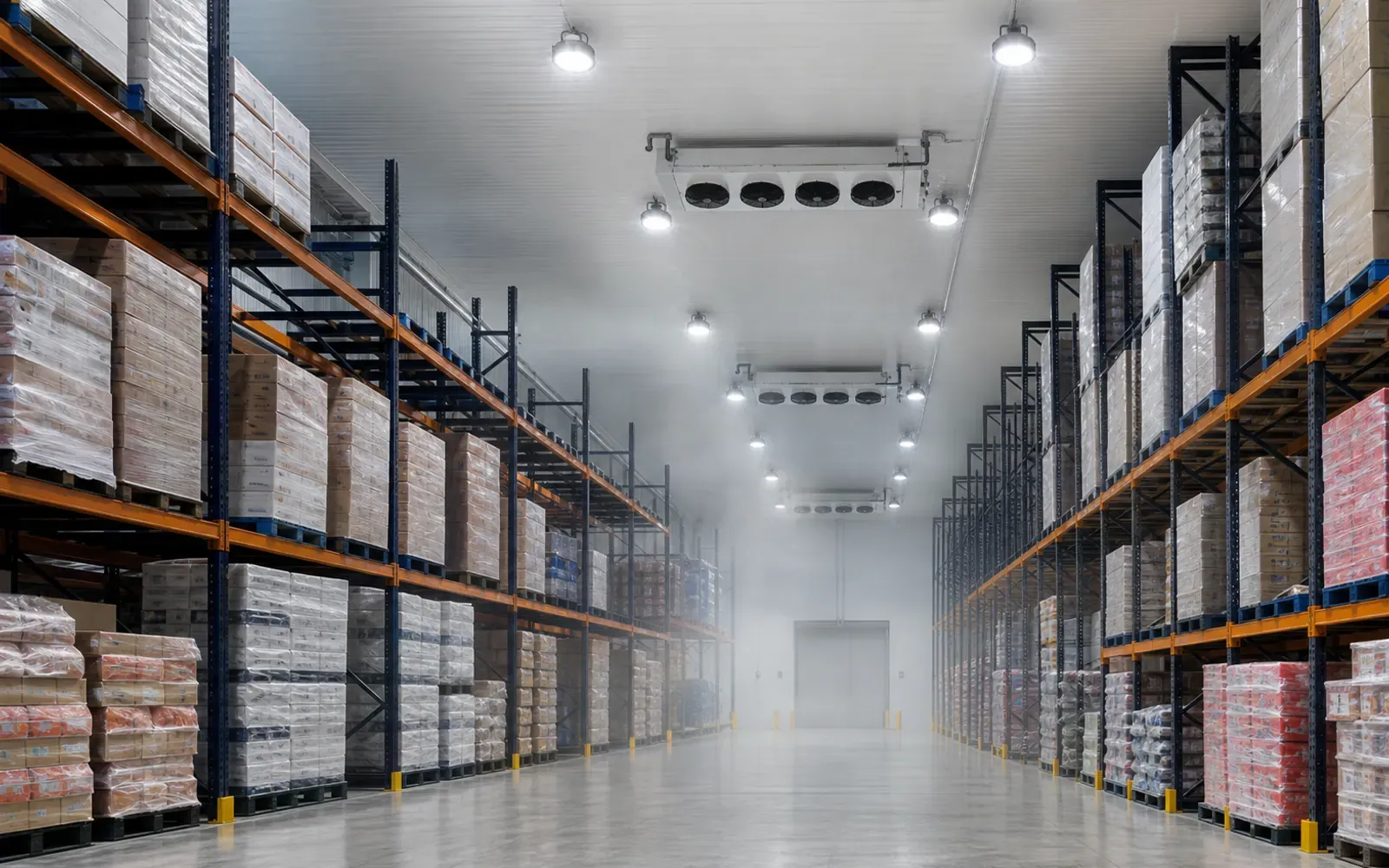
A freezer-rated high bay must do more than switch on at a low ambient temperature. It also has to tolerate repeated transitions through humid loading areas, protect seals and cable entries from condensation, and keep sensors reliable at the mounting height.
Procurement rule: write the minimum start temperature, continuous operating range and temperature transitions into the RFQ. “Cold-room suitable” is not a testable specification.
Divide the facility into thermal zones
A cold-chain building is rarely one environment. Map:
- deep-freeze rooms;
- chilled storage;
- ante-rooms and airlocks;
- loading docks exposed to outdoor humidity;
- defrost or washdown areas;
- plant rooms above insulated ceilings.
The most severe condition may be the humid transition zone rather than the coldest room. Warm moist air can condense on a cold luminaire when doors open or equipment moves between zones.
Specify starting and operating temperature separately
Ask the supplier for the rated ambient range of the complete luminaire, including the LED driver, sensor, emergency pack, connector and cable. Confirm cold-start testing at the project voltage. A driver may operate after it has warmed internally but fail to start after a long shutdown at the minimum temperature.
If emergency batteries are needed, treat them as a separate thermal design problem. Battery chemistry, enclosure location and charging behavior may not match the luminaire’s low-temperature rating. Remote mounting outside the freezer is often easier to validate.
Control condensation and water ingress
Use a sealed luminaire with appropriate cable glands, gaskets and pressure management. The IP rating applies to the tested assembly, so changing the field cable or gland can undermine it. Request the test report and confirm the tested orientation.
Avoid creating a path for moist air through conduit. Follow local electrical practice for sealing penetrations and vapor barriers. Position drivers and junctions so maintenance does not damage insulated panels.
Select optics for racks, ice and reflectance
Cold-room surfaces can be highly reflective when clean and much darker after frost, packaging or dirt accumulates. Model a realistic maintenance factor. In rack aisles, evaluate vertical lux on product labels as well as floor lux. A linear aisle high bay may put more useful light on rack faces, while a UFO high bay suits open marshalling zones.
The comparison in UFO vs linear high bays for warehouse aisles provides a zone-by-zone decision method.
Check sensors at low temperature
PIR and microwave sensors behave differently around insulated panels, moving doors and cold-air curtains. Specify:
- rated ambient range;
- detection height and pattern;
- minimum detectable movement;
- standby output and hold time;
- behavior during door movement and defrost;
- accessible commissioning method.
Mock up one representative aisle. Walk and drive the full approach route, including entry from the cross-aisle. Confirm that the light reaches the required level before a forklift enters the working area.
Demand evidence at the complete-luminaire level
Independent lighting laboratories can test photometry, environmental exposure, moisture, IP/IK, vibration and extreme temperatures (UL lighting performance capabilities). Ask for reports that identify the exact model, driver and configuration offered.
A useful submittal contains:
- dimensional drawing and installation instructions;
- low-temperature start and operating declaration;
- IP/IK test evidence;
- IES or LDT photometric file;
- driver and sensor datasheets;
- gasket, cable and connector materials;
- warranty exclusions and ambient limits.
Plan maintenance before installation
Lift access inside a freezer is disruptive. Favor serviceable drivers, captive fasteners and connectors that can be handled with insulated gloves. Agree on spare drivers, sensors, gaskets and complete luminaires. Label each circuit and fixture position in the as-built drawing.
Do not accept lifetime claims without their temperature assumptions. Use the process in LM-79, LM-80 and TM-21 for LED buyers to separate complete-luminaire performance from LED-package projections.
Sample cold-storage RFQ wording
“Luminaire shall start and operate at the scheduled minimum ambient temperature and shall be suitable for repeated cold/humid transitions. Supplier shall identify ratings for the complete configuration, including driver, sensor, connector and emergency option. Submit low-temperature start evidence, ingress-protection report, photometric file and warranty ambient limits.”
This clause does not replace a project-specific electrical specification, but it closes the common gap between a cold-rated LED package and a cold-ready luminaire system.