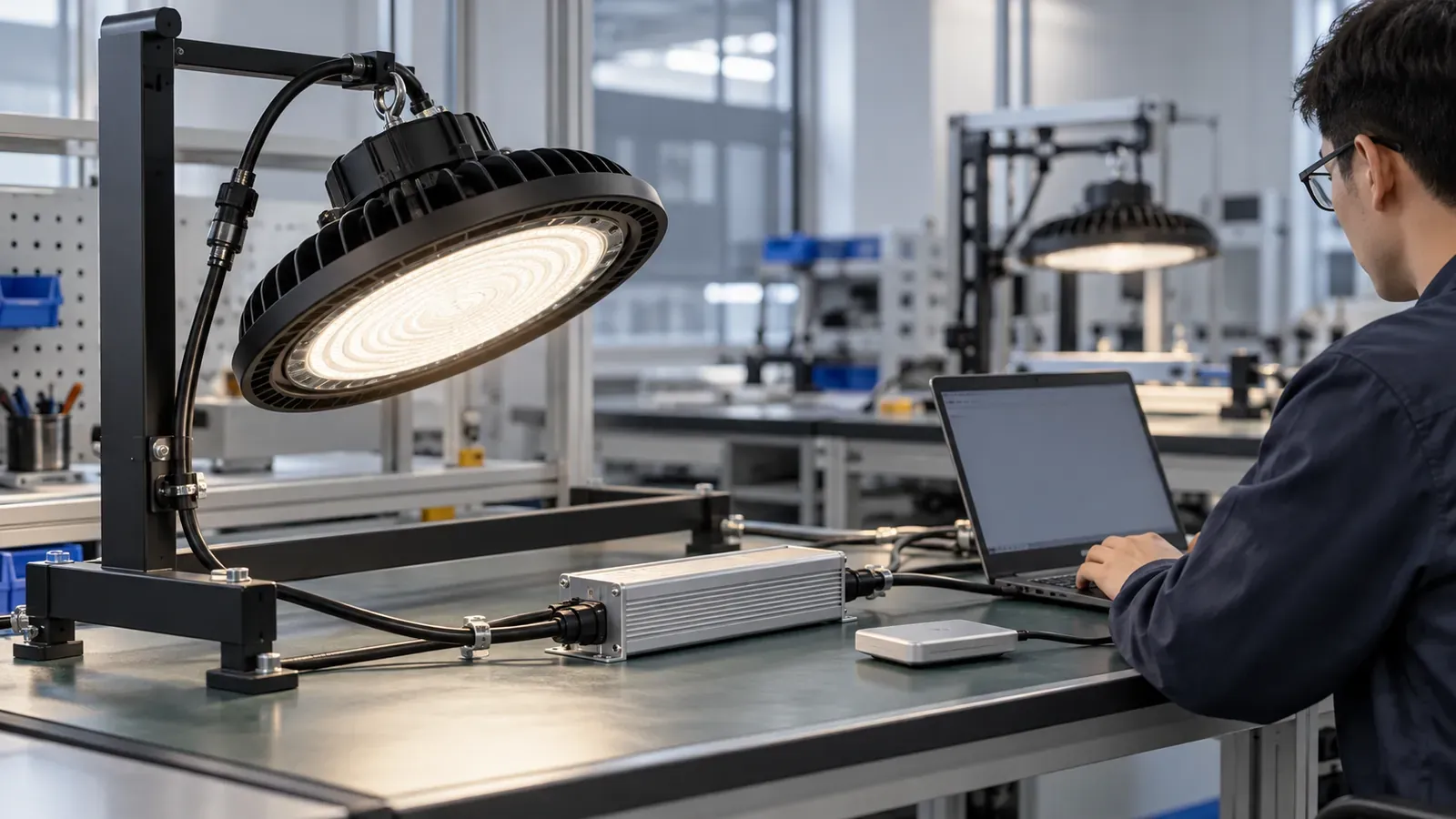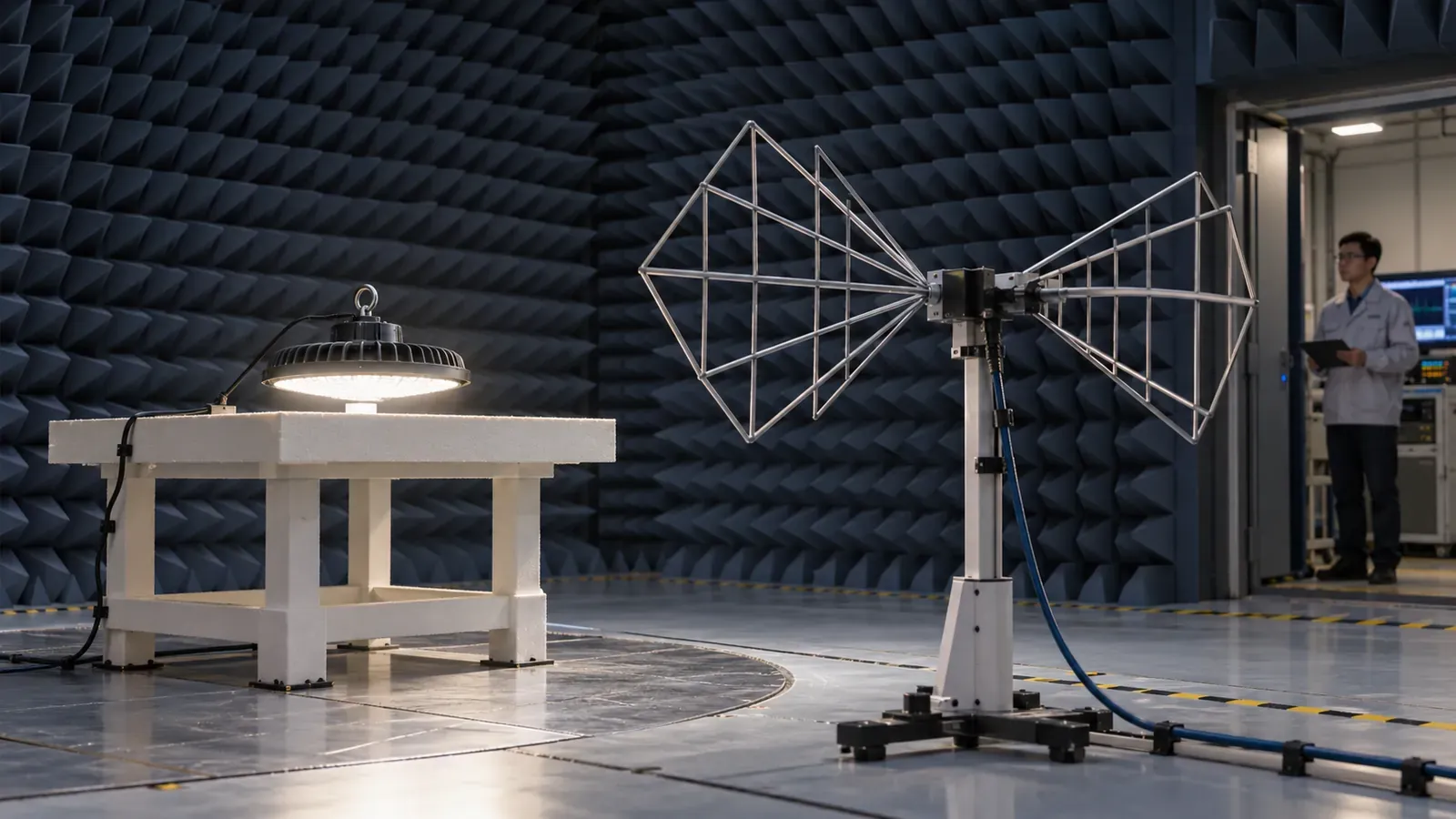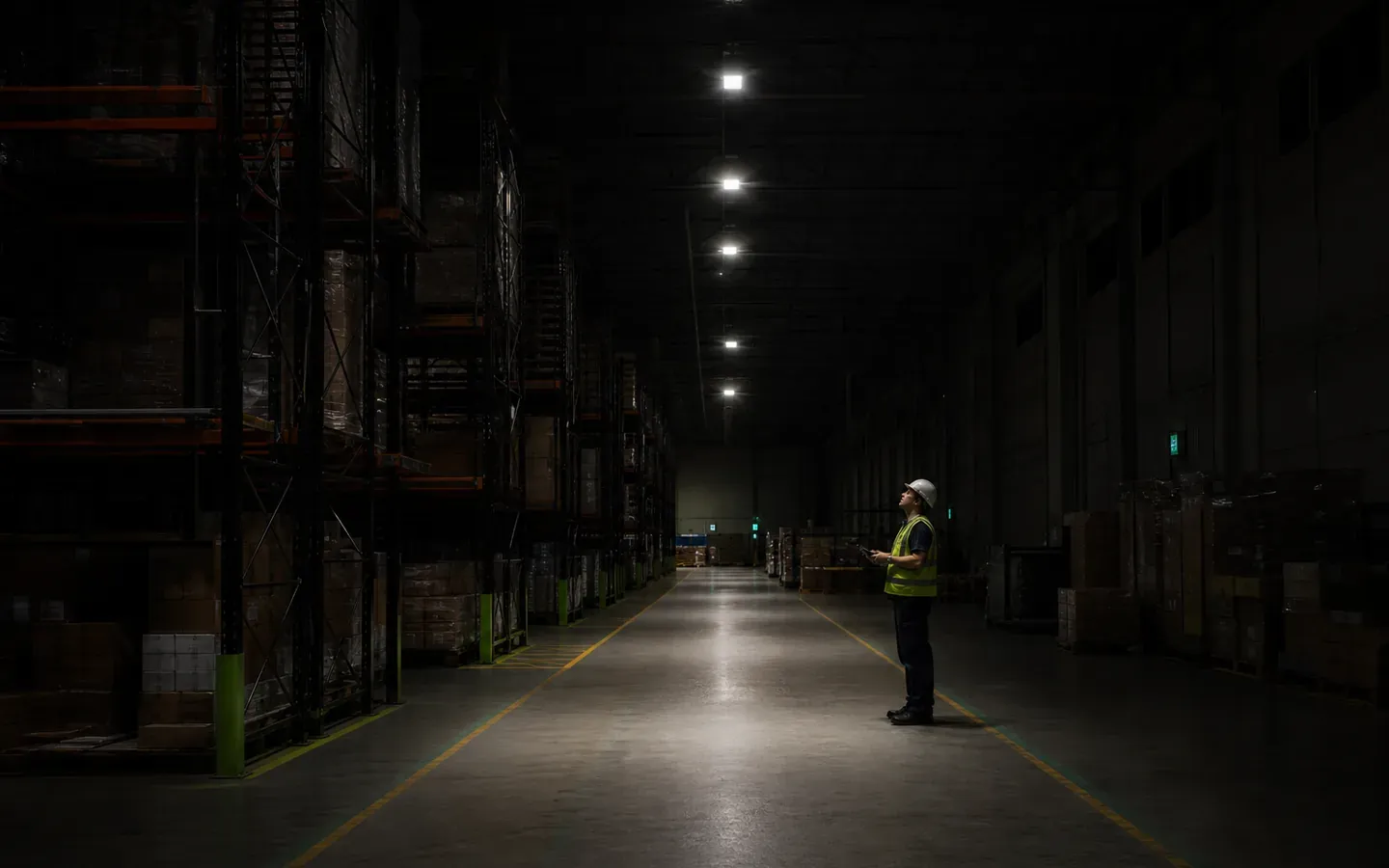
An “emergency option” on a high-bay quotation does not define a compliant egress system. Buyers must establish the required emergency light level, duration, operating mode, ambient conditions, test method and maintenance responsibility under the local life-safety design.
Safety boundary: emergency lighting is code-driven. A qualified designer and the authority having jurisdiction must approve the layout and equipment; the luminaire supplier should provide verifiable product data for that design.
Start with the emergency lighting plan
Map escape routes, exits, stairs, changes of level, fire equipment, open work areas and high-risk tasks. Record which luminaires are on emergency supply and what happens when only a local lighting circuit fails.
Do not assume that a small percentage of normal high bays will create adequate light at floor level. Model the emergency output distribution at the required planes and verify minimum values and uniformity defined by the applicable code.
Choose the backup architecture deliberately
Common approaches include:
- a self-contained battery and emergency driver in or near selected luminaires;
- a central battery system feeding designated emergency luminaires;
- a generator or UPS-backed emergency circuit;
- a hybrid arrangement for different areas.
The right choice depends on ceiling height, maintenance access, ambient temperature, monitoring, circuit design and required transfer behavior. High ceilings can make self-contained battery replacement expensive even when the initial wiring looks simple.
Specify emergency output, not battery watts
Request delivered lumens and distribution in emergency mode, not only emergency-driver wattage. Confirm which LED module is energized, its current, optical path and expected output through the full rated duration.
| Required data | Why it matters |
|---|---|
| Initial emergency lumens | Enables the design calculation |
| Output at end of duration | Checks maintained performance |
| Photometric distribution | Shows where emergency light lands |
| Transfer behavior | Defines response to supply failure |
| Charge time/status | Supports readiness and monitoring |
| Battery type and temperature range | Affects capacity and service life |
IEC 60598-2-22 specifies particular requirements for emergency luminaires and includes updated requirements for lithium batteries and high-temperature operation (IEC standard overview). Use the edition and regional adoption required by the project.
Review temperature at the battery location
The air near a warehouse roof can be much hotter than the occupied zone. In cold stores, the opposite problem applies. Ask for the battery’s permitted charging, discharging and storage temperatures, plus expected replacement interval at the measured location.
Remote mounting can improve service access or temperature exposure, but cable length, enclosure, fire protection and manufacturer instructions must be reviewed. For extreme environments, coordinate with the high-temperature or cold-storage high-bay guide.
Define normal, emergency and control behavior
State whether each luminaire is maintained or non-maintained and how it interacts with occupancy sensors, DALI, 0–10V and local switching. Emergency operation should not depend on a cloud connection or an occupancy command that can leave the route dark.
Test loss of normal supply, branch-circuit failure where required, control-bus failure and power restoration. Prevent sudden simultaneous restart from causing breaker trips; see the high-bay inrush guide.
Make inspection and testing practical
Define local test switches, self-test indicators, central monitoring or another approved method. Indicators must be visible from a maintainable position and mapped to asset IDs. Provide safe access to batteries and replaceable parts.
Handover should include:
- approved emergency calculation;
- circuit and device schedule;
- test certificates and product instructions;
- functional test results;
- battery commissioning dates;
- routine inspection and duration-test plan;
- spare-part and replacement procedure.
RFQ clause
“Provide emergency high-bay equipment suitable for the approved life-safety design. Submit initial and end-of-duration emergency lumens, photometric distribution, rated duration, transfer behavior, charging data, battery chemistry and temperature limits, applicable certification, control override logic, self-test method and replacement instructions.”
Choose the normal-lighting platform—such as UFO or linear high bays—only after confirming that the emergency configuration is tested and documented for that exact model.