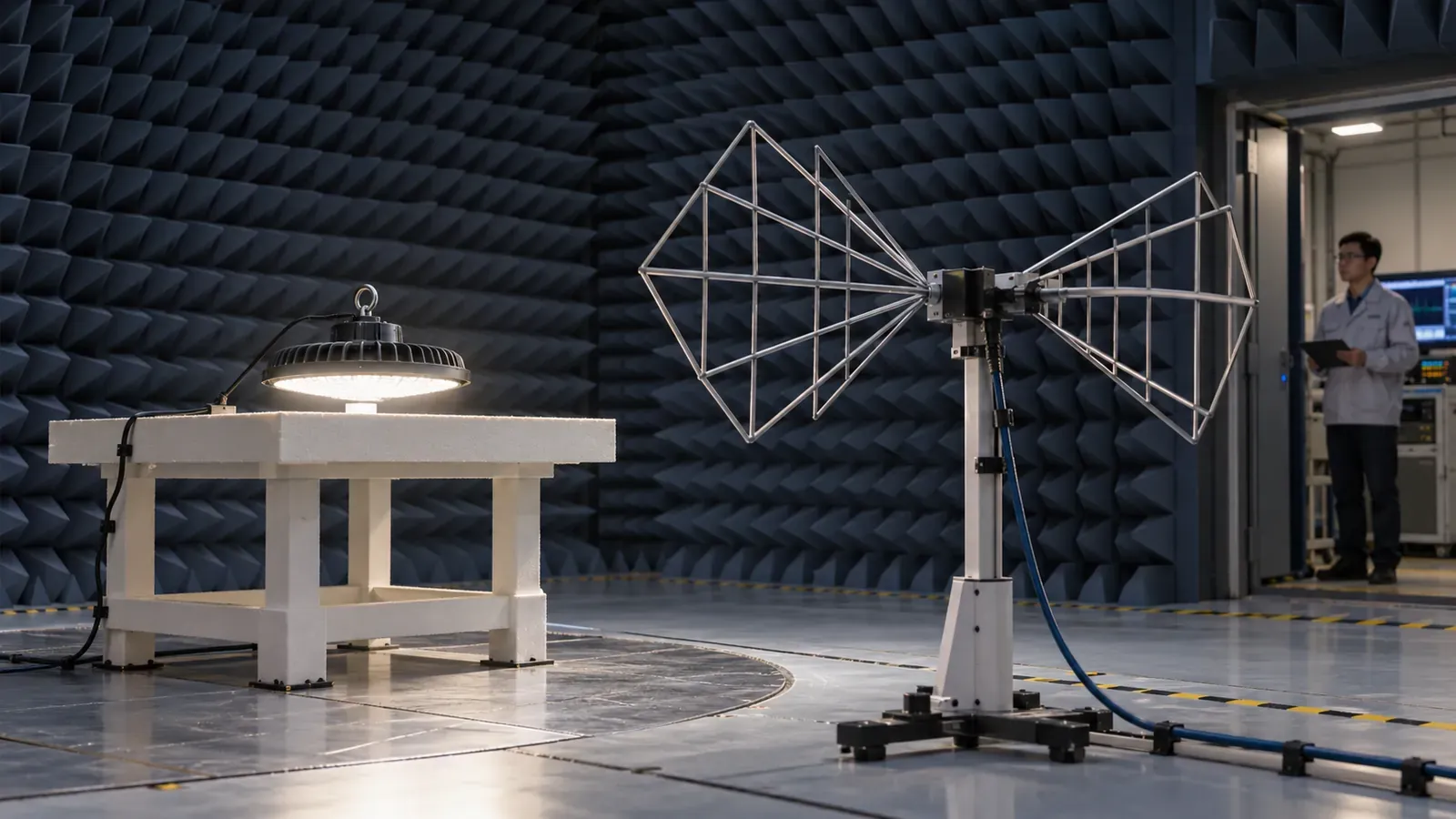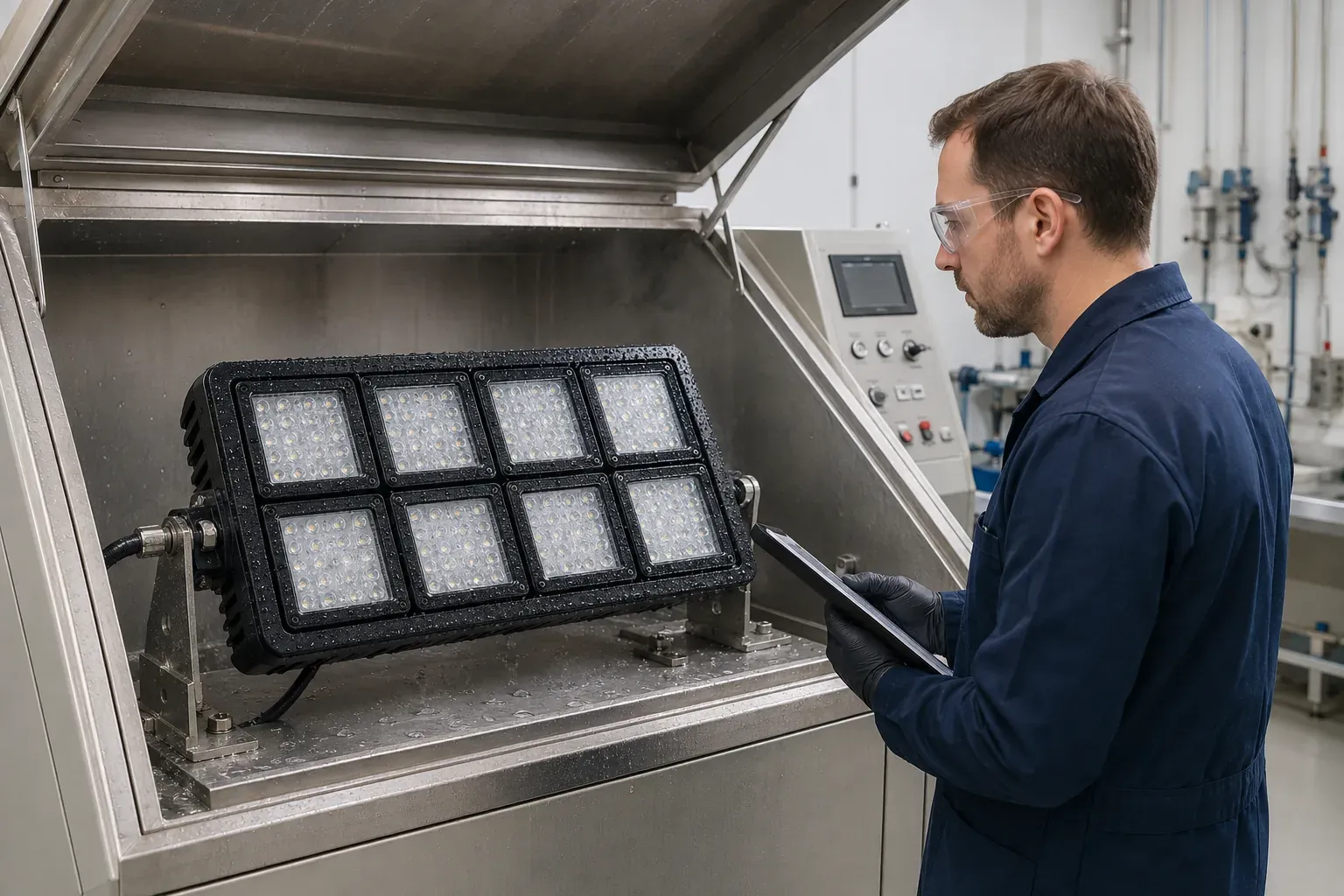
A coastal LED floodlight can pass an IP test and still corrode around its bracket, fasteners, cable gland or coating defects. For ports, shipyards, coastal sports grounds and seaside industrial sites, buyers therefore need more than “IP66” and a supplier’s claim of “1,000-hour salt spray resistance.” They need a defined environment, a reviewable test method, acceptance criteria and evidence tied to the exact production assembly.
This guide explains how to specify a coastal LED floodlight salt spray test without converting cabinet hours into an invented service-life promise. It also shows which material interfaces and documents should be checked before a B2B order is released.
Short answer: is 1,000 hours of salt spray enough?
Not by itself. A test duration has meaning only when the buyer also knows the method, specimen, preparation, cabinet conditions, inspection points and pass/fail criteria. One thousand hours on a flat coated coupon is not equivalent to one thousand hours on a complete luminaire with cut edges, screws, bracket pivots, glands and dissimilar metals.
Use salt spray testing as controlled evidence of coating and assembly consistency. Do not state that 500, 1,000 or 2,000 laboratory hours equal a fixed number of coastal service years. The real site includes wet/dry cycles, ultraviolet radiation, temperature changes, pollutants, abrasion, maintenance and salt deposits that a continuous cabinet test does not reproduce.
1. Define the coastal exposure before requesting a rating
“Near the sea” is too vague for a quotation. Give suppliers the information needed to select materials and a coating system:
- distance and orientation relative to the shoreline;
- direct sea spray versus airborne salt only;
- prevailing wind, rainfall and sheltering;
- humidity, temperature range and time of wetness;
- industrial, fertilizer, chlorine or sulfur pollutants;
- mounting height and whether surfaces can be rinsed;
- expected cleaning and maintenance interval;
- required design life and warranty conditions.
A luminaire under a covered quay can retain salt longer than one exposed to regular rain. A floodlight beside a chemical plant may face combined chloride and industrial pollution. Divide the project into exposure zones instead of assigning one generic requirement to every pole.
For the broader lighting layout, optics and high-mast service plan, use the port and container-yard floodlight guide. This article focuses specifically on corrosion evidence.
2. Understand what ISO 9227 does—and does not—prove
ISO 9227:2022 specifies equipment, reagents and procedures for neutral salt spray (NSS), acetic acid salt spray (AASS) and copper-accelerated acetic acid salt spray (CASS). For most coated aluminum or steel luminaire discussions, the RFQ should identify the selected method rather than simply saying “salt spray tested.”
The ISO summary makes two procurement limits especially important:
- the standard does not set the specimen type, exposure duration or interpretation for a particular product; those belong in the product specification;
- the methods are not intended to predict long-term field durability or rank unrelated materials against one another.
Therefore, “tested according to ISO 9227” is incomplete. The buyer still needs to define which assembly is tested, for how long, how it is prepared and what counts as failure.
3. Separate IP protection from corrosion resistance
IP and corrosion tests answer different questions. An IP66 enclosure may resist dust and powerful water jets at the time of testing, while exposed screws, a steel bracket or damaged coating can still corrode in salt-laden air. Corrosion can later affect sealing surfaces, drainage, aiming hardware and earth continuity.
IEC 60598-1:2024 is the current general safety standard for luminaires, covering construction and related safety tests. Compliance with a luminaire safety standard is essential where applicable, but it should not be presented as a complete coastal durability specification.
Keep these lines separate in the RFQ:
| Requirement | What it addresses | Evidence to request |
|---|---|---|
| IP rating | Dust and water ingress | Report for the complete offered configuration |
| Salt spray test | Coating or assembly response in a defined artificial atmosphere | Method, hours, specimen and acceptance record |
| Material schedule | Suitability of housing, bracket, screws and glands | BOM extract and material grades |
| Site maintenance | Removal of deposits and early defect detection | Cleaning and inspection instructions |
4. Use C5 or CX terminology carefully
ISO 12944-2:2017 classifies environments for steel structures and explains that environmental corrosivity is a key input when selecting protective paint systems. C5 and CX terminology can help describe severe atmospheric exposure, but a luminaire is not a simple steel panel. It contains aluminum castings, stainless or coated fasteners, glass or polymer optics, cable entries, seals and electrical interfaces.
If a supplier claims “C5” or “CX,” ask:
- which standard part and durability system the claim refers to;
- which substrate and coating stack were evaluated;
- whether the evidence is for a coupon, a component or the complete luminaire;
- whether edges, holes, threads and coating damage were represented;
- which laboratory tests and acceptance criteria support the declaration.
Do not copy a structural-steel paint category into a luminaire schedule without translating it into product-specific construction and verification requirements.
5. Test the complete production-representative assembly
Flat coupons are useful for controlling pre-treatment and powder-coating batches, but they cannot reveal every product failure path. A project qualification should include a complete production-representative luminaire where chamber capacity and the agreed method allow.
The tested sample should match the order in:
- aluminum alloy and casting process;
- pre-treatment, primer, powder chemistry, color and coating thickness;
- bracket material and surface treatment;
- fastener, washer and locking-hardware grades;
- cable gland, vent, connector and cable jacket;
- glass, lens frame, gasket and sealant;
- machining performed before or after coating;
- laser marking, labels and any drilled accessory holes.
Require sample photographs and model identification in the report. If a large wattage uses a different bracket or housing from the tested model, the supplier should provide a documented technical rationale or additional evidence—not simply extend the result to the entire family.
6. Control galvanic corrosion and water traps
Coating quality is only one part of marine design. Galvanic corrosion can occur when dissimilar metals are electrically connected in the presence of a conductive electrolyte such as salt water. Risk depends on the material pair, exposed area ratio, isolation method and actual wetting.
Review interfaces such as stainless screws in aluminum castings, steel brackets against aluminum housings, copper-containing terminals near drainage paths and field-installed hardware. Suitable isolation washers, compatible coatings, sealed interfaces and drainage can reduce risk, but each choice must also preserve mechanical strength, earthing and thermal performance.
Look for crevices and horizontal pockets that retain solution. Confirm that the declared mounting orientation allows drainage and that the breather or pressure equalization device is not positioned as a water collector. For serviceable high-output products, the modular LED floodlight page shows why bracket and module interfaces must be considered as part of the whole assembly.
7. Put measurable acceptance criteria in the test plan
“No corrosion” is difficult to audit unless inspection conditions and defect definitions are agreed. The protocol should state which surfaces are evaluated, when inspections occur, whether samples are rinsed or conditioned before assessment and which changes are acceptable.
Possible project-specific checks include:
- no red rust on defined steel surfaces;
- no coating blistering, peeling or loss of adhesion beyond agreed limits;
- no unacceptable white corrosion products on aluminum or zinc-coated parts;
- no corrosion that blocks bracket adjustment or fastener removal;
- no cracking or loss of sealing at glands, gaskets and interfaces;
- legible safety markings after the test;
- successful visual, insulation, earth-continuity and functional checks after conditioning, where applicable.
Acceptance limits should come from the project specification and relevant standards, not be invented after the chamber is opened. Record both compliant and non-compliant areas with close photographs and a scale.
8. Review the report, not just the certificate cover
A useful ISO 9227 luminaire test report should identify:
| Report item | Buyer question |
|---|---|
| Laboratory and authorization | Who performed and approved the work? |
| Standard edition and method | NSS, AASS or CASS, and under which edition? |
| Cabinet parameters | Were solution, pH, temperature and collection conditions recorded? |
| Sample identity | Does the model, wattage and BOM match the quotation? |
| Preparation | Was the specimen scribed, cut or otherwise conditioned? |
| Mounting and orientation | Were water traps and exposed interfaces represented? |
| Duration and interruptions | Was the agreed exposure completed continuously and documented? |
| Acceptance result | Which criteria were applied to each material and function? |
| Photographs | Can pre-test and post-test construction be compared? |
A short pass certificate without these links is weak evidence. During supplier qualification, compare report photos, drawings and critical materials with the production file. The industrial lighting factory-audit guide explains how to verify pre-treatment controls, curing records, gauges and calibrated test equipment.
9. Freeze the process and inspect production
A qualified sample does not protect the order if production uses a different powder supplier, thinner coating, untreated bracket or lower-grade screws. Freeze the approved bill of materials and process parameters, including pre-treatment stages, cure window and coating-thickness range. Require written approval for substitutions.
At pre-shipment inspection, check production against the golden sample and documents. Useful checks include coating appearance and thickness sampling, fastener magnet/material verification where appropriate, gland and vent part numbers, edge coverage, bracket movement, drainage features and packaging protection. Do not perform an improvised salt-water spray on finished goods and call it an ISO 9227 test.
Packaging also matters: metal parts rubbing during sea freight can damage coating before installation. Isolate brackets and hardware, prevent trapped moisture and inspect cartons after any container condensation event.
Coastal LED floodlight RFQ wording
Use project-specific values in the brackets:
The complete coastal LED floodlight, including housing, optical assembly, bracket, fasteners, cable gland, vent and external connectors, shall use the approved corrosion-control materials and coating system. Submit an ISO 9227:2022 [NSS/AASS/CASS] report for [duration] hours identifying the exact sample, preparation, cabinet parameters, inspection intervals and agreed acceptance criteria. Salt spray duration shall not be represented as an equivalent number of field-service years. Provide the material grades, coating pre-treatment and thickness range, dissimilar-metal isolation details, and evidence linking the tested sample to the offered SKU. Any change to these items requires written buyer approval.
Add separate requirements for IP, IK, surge protection, photometry, ambient temperature, vibration and safety certification. Coastal reliability is a system property, not a single test-hour number.
Final purchasing checklist
Before approving a marine-grade LED floodlight supplier, confirm that:
- the site exposure and maintenance conditions are documented;
- the selected salt spray method and duration are stated;
- the complete tested assembly matches the quotation;
- acceptance criteria cover coating, hardware, interfaces and post-test function;
- C5 or CX language is supported by a clearly defined scope;
- production materials and coating processes are frozen;
- inspection and maintenance plans protect the result after shipment.
The strongest coastal specification does not ask for the largest hour number. It connects the real environment to materials, assembly details, controlled test evidence and production conformity.