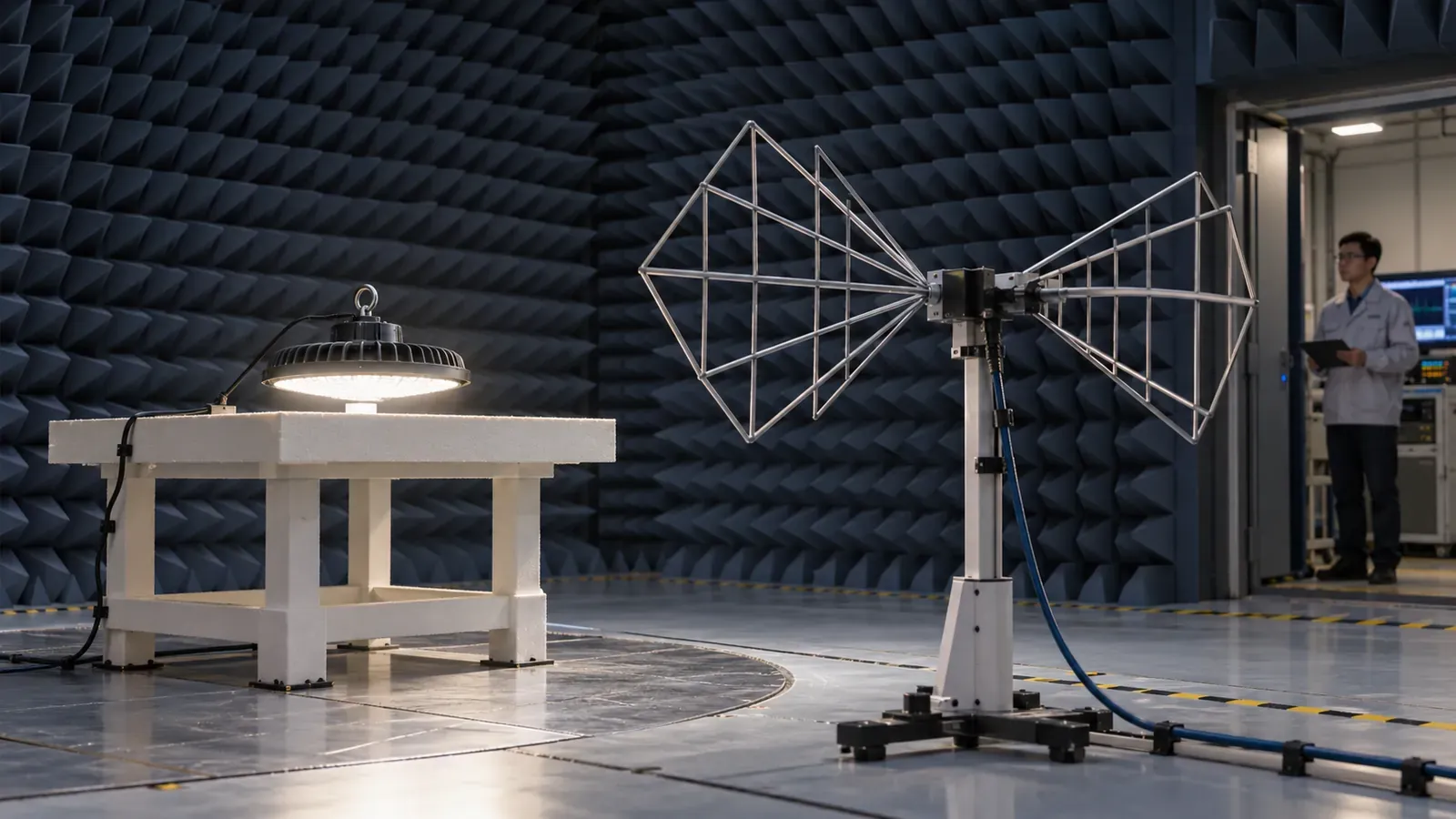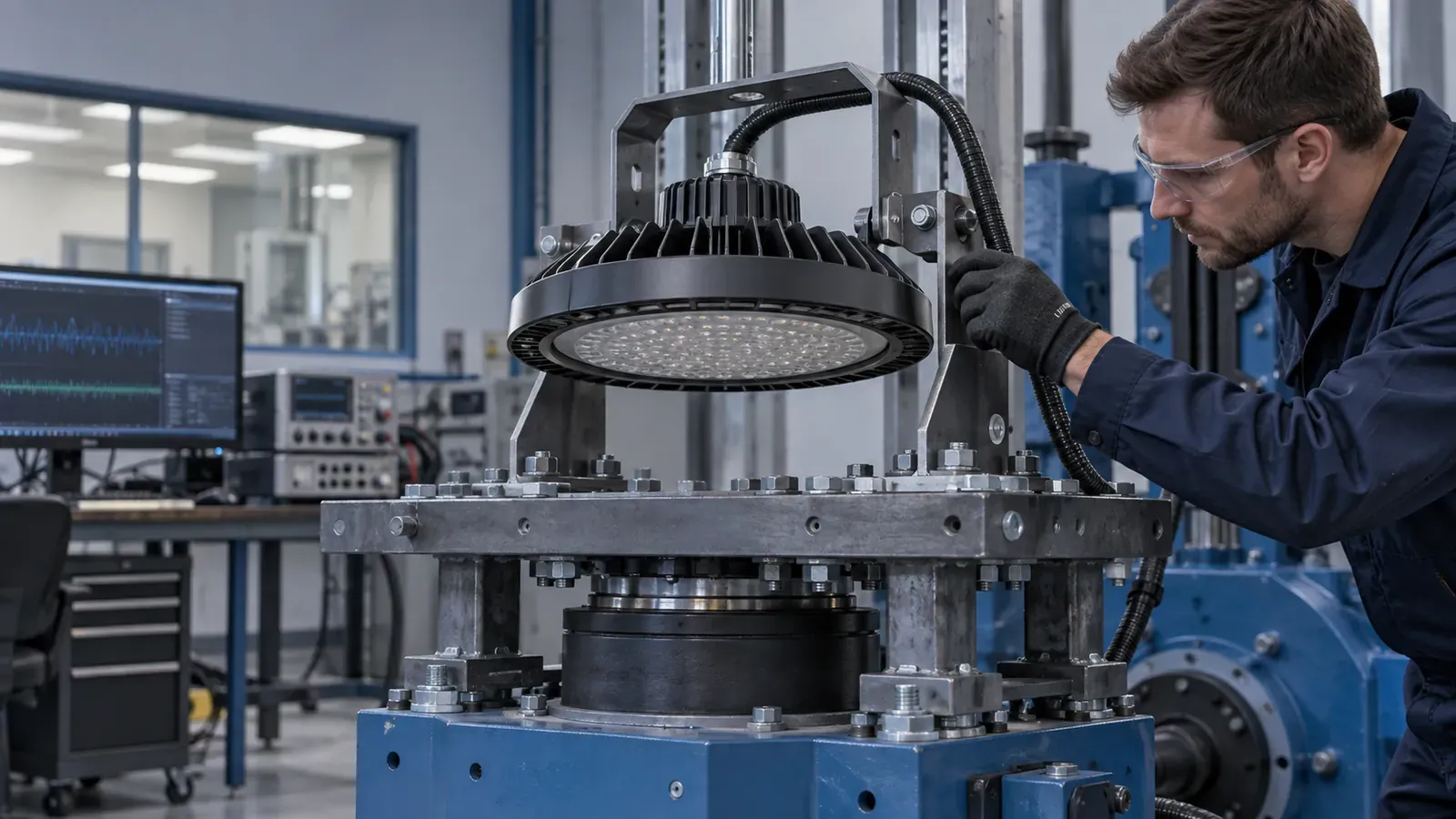
A high bay that performs well in a static warehouse may loosen, flicker or shift aim when installed on a crane structure or near heavy moving equipment. The purchasing question is not simply whether the housing is “heavy duty.” It is whether the complete offered luminaire and its actual mounting arrangement have been assessed against a vibration profile relevant to the site.
This guide is for importers, project engineers and maintenance teams writing an LED high bay vibration test for crane bays into a B2B RFQ. It focuses on evidence a supplier can supply and a buyer can verify—not on an invented universal “crane-proof” rating.
Short answer: what belongs in the RFQ?
Define where the fixture will be mounted, obtain or estimate the site’s vibration environment, agree the test method and severity, and require a report for the complete production-representative luminaire with its bracket, fasteners, driver and cable entry. Set pass/fail criteria for physical integrity, electrical operation and retained light direction. A certificate saying only “vibration tested” is not enough.
1. Separate vibration from impact, ingress and wind
Repeated vibration can fatigue a bracket, relax a fastener, fret a connector or stress a driver component. A one-time strike is a different loading event. The IK08 vs IK10 high-bay guide addresses impact resistance; an IK code is not a vibration rating. Likewise, IP protection does not establish resistance to repeated dynamic loads.
Location matters. A luminaire fixed to a stationary roof truss above a crane bay may see a different environment from one mounted on the moving bridge, trolley or machinery frame. Ask the site engineer which structure actually supports the light before selecting a test. For an outdoor crane or container yard, also review the port-yard floodlight specification for corrosion, aiming and access requirements.
2. Match the test method to the excitation
IEC 60068-2-6:2007 describes a sinusoidal vibration test used to assess mechanical weakness or performance degradation at specified severities. IEC 60068-2-64:2008, amended 2019 covers broadband random vibration. IEC 60068-3-8:2003 provides guidance for choosing among stationary vibration methods from measured or estimated conditions.
Neither standard supplies one universal acceleration, frequency range or duration for every crane bay. Those are project inputs. A motor or gearbox may create strong periodic components; travel over rails and structural movement may produce a more complex profile. Ask a qualified test laboratory to choose a defensible method from site data. If there is no measurement, label the chosen profile as a project assumption and review the uncertainty.
| RFQ input | Why it matters |
|---|---|
| Mounting location and operating modes | Bridge travel, lifting and idling can differ |
| Frequency range and amplitude or acceleration | A single “g” number does not describe the whole test |
| Waveform, axes, duration and sweep or spectrum | Defines what the report actually covers |
| Installed orientation and bracket geometry | Changes load path and resonant behavior |
| Powered or unpowered state | Determines whether intermittent electrical faults can be detected during test |
3. Test the installed assembly, not only the housing
The weak point may be the hook, bracket, safety cable, driver attachment or cable gland rather than the aluminum body. The laboratory fixture should reproduce the intended mounting stiffness and orientation as closely as practical. Record bracket part number, bolt grade, tightening torque, thread-locking method if used, cable support and any secondary retention.
A component-only report is useful supporting evidence, but it is not proof for a heavier complete luminaire or a different bracket. This is especially important when comparing a UFO high bay with a modular floodlight: their masses, centers of gravity and mounting interfaces differ. Do not transfer a result across product families without an engineering justification.
4. Define acceptance before the laboratory starts
Agree the inspection baseline, test monitoring and post-test criteria in the purchase specification. A practical plan includes:
- Photograph and record the as-built specimen, serial number, hardware, torque marks and initial light aim.
- Check initial electrical operation, power, driver behavior and any relevant control function.
- Monitor for intermittent extinguishing, flicker or fault codes during powered portions of the test, if safe and specified.
- Inspect for cracked brackets, loose fasteners, lens movement, damaged seals, cable abrasion and displaced driver parts after each required axis.
- Recheck operation, mounting torque or witness marks and beam direction after the test; repeat ingress or photometric checks if the risk assessment calls for them.
Set measurable tolerances for aim shift, fastener movement and electrical performance where the project needs them. Do not claim that the IEC method itself defines your site’s pass/fail values; the relevant specification and contract do that.
5. Read the supplier report critically
A useful report names the exact luminaire model and configuration, sample count, revision, bracket, laboratory, standard edition, waveform, axes, frequencies, acceleration or displacement, duration, mounting fixture, operating state, observations and acceptance result. Request photos before and after testing plus calibration and traceability information.
Watch for a report on an earlier lightweight model, a bare housing, an unpowered specimen when live faults matter, or a different suspension method. A supplier’s headline number is not automatically comparable with another supplier’s: for example, Signify’s CraneMaster product page publishes a product-specific vibration claim, but its test setup and acceptance basis must be understood before using it as a project benchmark.
6. Carry the result into production and installation
A successful type test can be undermined by a substituted bracket, shorter bolt, altered driver fixing or different cable route. Freeze safety-relevant drawings and a bill of materials; require approval for changes. At factory audit and pre-shipment inspection, check hardware identity, assembly torque records, cable strain relief, serial traceability and carton protection.
Installation is the final interface. Confirm the supporting steelwork, approved fasteners, torque method, secondary retention and periodic inspection interval with the site’s structural and electrical teams. A laboratory test of the luminaire does not certify the crane structure or replace a site-specific safety assessment.
Copy-ready vibration RFQ clause
Supply [model/configuration] LED luminaires for installation on [exact structure and orientation]. Submit a complete-luminaire vibration report for the production-representative assembly, including bracket, fasteners, driver, optics and cable entry, tested to [IEC 60068-2-6 / IEC 60068-2-64 and edition] at the project-agreed [waveform, frequency range, severity, axes, duration and operating state]. Provide fixture and mounting drawings, initial and final inspection records, electrical monitoring results and acceptance criteria. No cracking, detached parts, unsafe loosening, intermittent outage or aim shift beyond [project limit] is permitted. Any change to tested safety-relevant components requires written approval and reassessment.
Use the broader industrial lighting RFQ checklist for electrical, optical, documentation and warranty terms. The core buying principle is simple: specify the exposure and the assembly, then ask for evidence against agreed failure criteria.