IK08 and IK10 appear on many industrial LED high bay datasheets, but the two ratings are not interchangeable. Under the IK code, IK08 corresponds to a 5-joule impact level while IK10 corresponds to 20 joules. That fourfold difference in test energy can matter in loading zones, sports halls and low-mounted industrial areas—but a higher number is not automatically necessary for every warehouse ceiling.
For B2B buyers, the real task is to match the impact risk to the correct rating and verify that the report covers the exact luminaire assembly being ordered. This guide explains how to make that decision without treating “IK10” as a vague synonym for heavy duty.
Short answer: IK08 or IK10?
Consider IK08 for high-mounted general warehouse and factory zones where direct impacts are unlikely and the luminaire is outside normal equipment reach. Consider IK10 where credible 20-joule-class impacts may occur, such as public-access areas, some sports halls, low-mounted service bays or locations exposed to material-handling equipment.
Do not decide from mounting height alone. A forklift mast, moving crane component, stored material or maintenance tool can reach a high fixture. Map the actual impact sources, directions and consequences before setting the requirement.
1. What the IK code actually classifies
IEC 62262 classifies the degree of protection an electrical-equipment enclosure provides against external mechanical impacts. The code addresses the enclosure and its ability to protect the equipment under a standardized test severity. It is not a general certificate for every form of mechanical durability.
The commonly compared upper levels are:
| IK rating | Impact energy | Procurement meaning |
|---|---|---|
| IK07 | 2 J | Moderate impact protection; may be insufficient for exposed industrial zones |
| IK08 | 5 J | Common specification for protected or high-mounted industrial luminaires |
| IK09 | 10 J | Intermediate option when available and supported by evidence |
| IK10 | 20 J | Higher protection for credible severe-impact or public-access risks |
Impact energy is a repeatable laboratory severity, not a promise that any object of any shape, speed or contact point will leave the luminaire undamaged.
2. How the impact test is performed
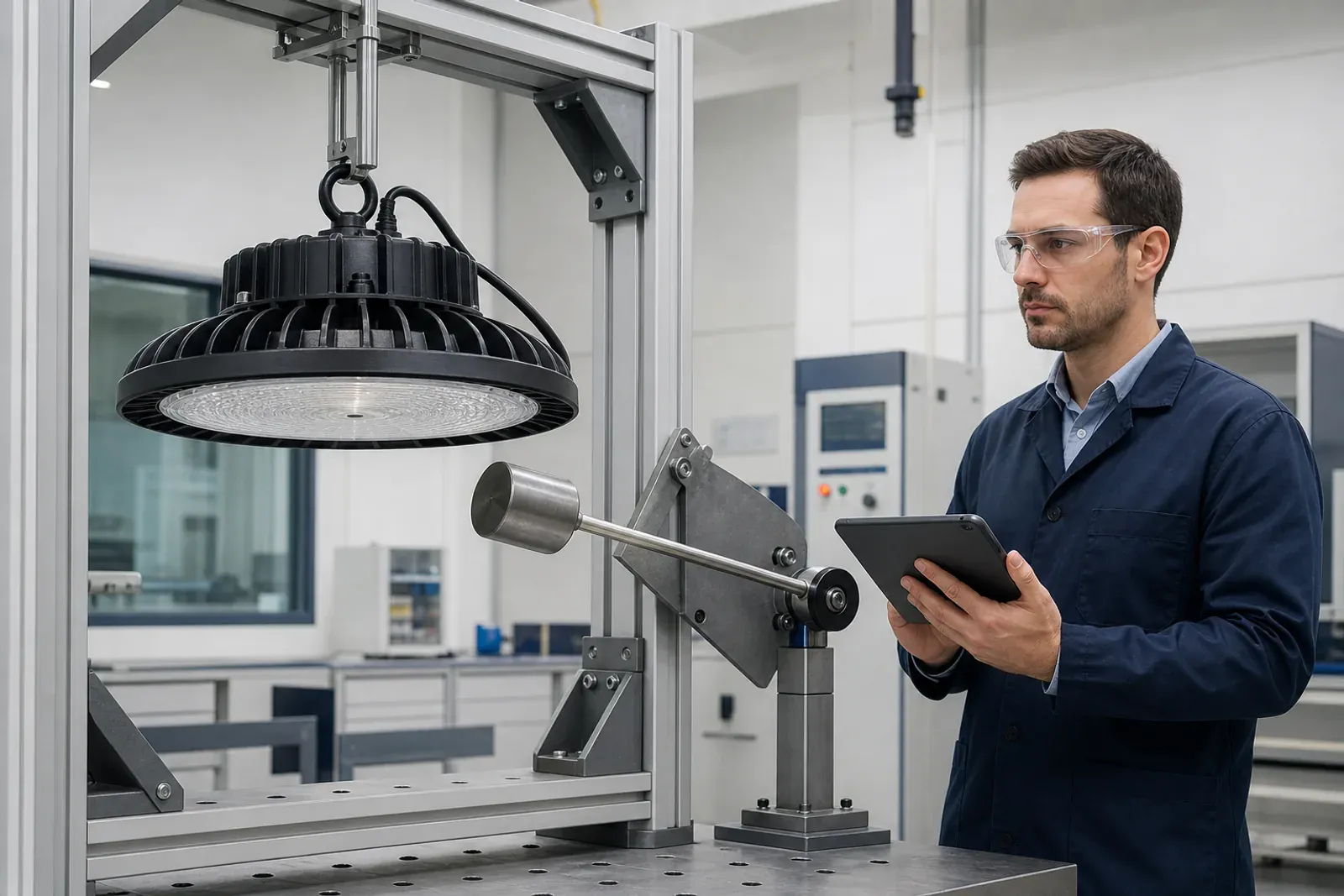
IEC 60068-2-75 provides coordinated hammer-test methods for electrotechnical products. A test applies prescribed impacts at defined energy levels, directions and locations using suitable apparatus. The exact procedure and acceptance criteria also depend on the relevant product standard and test plan.
That detail matters because a rating based only on the metal housing may not establish the same protection for the optical cover, sensor window, driver compartment or cable entry. Ask whether the complete production configuration was tested with its actual lens, gasket, fasteners and accessories.
3. IK rating does not cover every mechanical hazard
An IK rating should not be used as proof of:
- vibration resistance from machinery or transport;
- drop resistance during shipping or installation;
- corrosion resistance in chemical or coastal environments;
- protection from dust or water, which is addressed separately by the IP code;
- suitability for explosive atmospheres;
- long-term UV stability of a polycarbonate cover;
- strength of the hook, bracket, safety cable or building attachment.
For dusty or wet facilities, specify IP and IK independently. The food-plant and washdown high-bay guide explains why a strong enclosure can still fail if seals, materials or cleaning compatibility are unsuitable.
4. Select the rating by risk zone
Divide the facility into zones instead of applying IK10 everywhere. Review the likely impact source, whether it can physically reach the luminaire, how often exposure occurs and what happens if the cover or housing fails.
| Zone | Impact questions | Typical specification approach |
|---|---|---|
| High open warehouse ceiling | Can lifts, cranes or stored loads reach the fixture? | IK08 may be proportionate when exposure is remote |
| Rack aisle ends | Can a mast, pallet or long load enter the fixture envelope? | Review mounting and guarding; consider higher IK |
| Loading and maintenance bay | Are tools, hoses or equipment used near the luminaire? | IK10 may be justified at exposed positions |
| Indoor sports hall | What balls or equipment can strike the fixture, and from which direction? | Evaluate IK10 plus a suitable guard if required |
| Public-access low bay | Is vandalism or deliberate impact credible? | IK10 is often the more defensible starting point |
| Heavy process area | Are there vibration, heat or chemicals in addition to impact? | IK is only one part of a project-specific package |
The final choice should come from the project risk assessment and local requirements. The broader warehouse high-bay specification guide provides the geometry and operating inputs needed alongside the impact requirement.
5. Check what part of the luminaire achieved the rating
A datasheet may show one IK value even when different parts have different vulnerabilities. Tempered glass, polycarbonate, aluminum housings, sensor lenses and connector covers do not respond identically. A product family may also change its construction between wattages or optics.
Ask the supplier to identify:
- the exact tested model and wattage;
- optical-cover material and thickness;
- whether the driver compartment and sensor option were included;
- which mounting arrangement was used;
- every accessory needed to achieve the declared rating;
- whether the rating applies to the complete luminaire or only a component.
If a wire guard is required for IK10, include its part number in the quotation and calculation. A guard can change appearance, cleaning behavior, shadows and potentially the photometric distribution, so it should be part of sample approval.
6. Request a reviewable test report
A logo or one-line datasheet claim is not enough for a significant tender. Request the relevant report or report extract and verify that it identifies the standard edition, test laboratory, sample code and result.
The evidence package should show, where applicable:
- tested model, construction and sample photographs;
- declared impact energy and hammer method;
- impact locations, directions and number of impacts;
- mounting and support conditions;
- inspection and functional checks after testing;
- report date, authorization and laboratory credentials;
- relationship between the report model and the commercial SKU.
During a supplier review, compare the report photographs and bill of materials with the offered product. The industrial lighting factory-audit guide provides additional controls for test equipment, calibration and change management.
7. Understand the material tradeoffs
Higher impact protection may require a thicker polycarbonate optic, reinforced casting, protected fasteners or an external guard. These measures can add weight, cost and cleaning complexity. Optical changes may also affect lumen output, beam distribution and glare.
Do not accept a last-minute lens substitution solely to obtain a higher IK claim. Require updated photometric, thermal and material evidence. Polycarbonate can offer strong impact behavior, but its UV, chemical and temperature suitability must match the environment. Tempered glass may retain optical clarity and chemical resistance but behaves differently under concentrated impact.
8. Freeze the approved configuration before production
Approve a sample that matches the tested construction. Record the housing, cover, gasket, fasteners, sensor window, bracket or hook and any protective guard. Treat changes to these parts as controlled substitutions requiring review.
At pre-shipment inspection, verify labels and construction against the golden sample. Inspect for cracked covers, loose guards, casting damage and incorrect fasteners. This is a production-conformity check, not a substitute for repeating a standardized IK test on the factory floor.
IK08 vs IK10 high bay RFQ wording
Use wording that connects the rating to evidence and the delivered configuration:
The complete LED high-bay luminaire shall provide a minimum impact-protection rating of [IK08/IK10] in accordance with IEC 62262 or the applicable adopted regional standard. Submit a test report identifying the exact model, optical cover, mounting condition, impact energy, impact locations and post-test result. The delivered housing, lens, fasteners, sensor option and protective accessories shall match the tested and approved configuration. Any component substitution requires written approval and updated supporting evidence.
Add separate requirements for IP rating, vibration, corrosion, safety cable and hazardous-location certification where the application requires them. Do not assume the IK line covers those risks.
Final purchasing check
IK08 provides 5-joule impact classification; IK10 raises that standardized level to 20 joules. The right choice is the lowest rating that fully addresses the credible project risk and applicable requirements—not simply the highest number available. Define the zone, verify the complete tested assembly, review the report and freeze the approved construction before mass production.