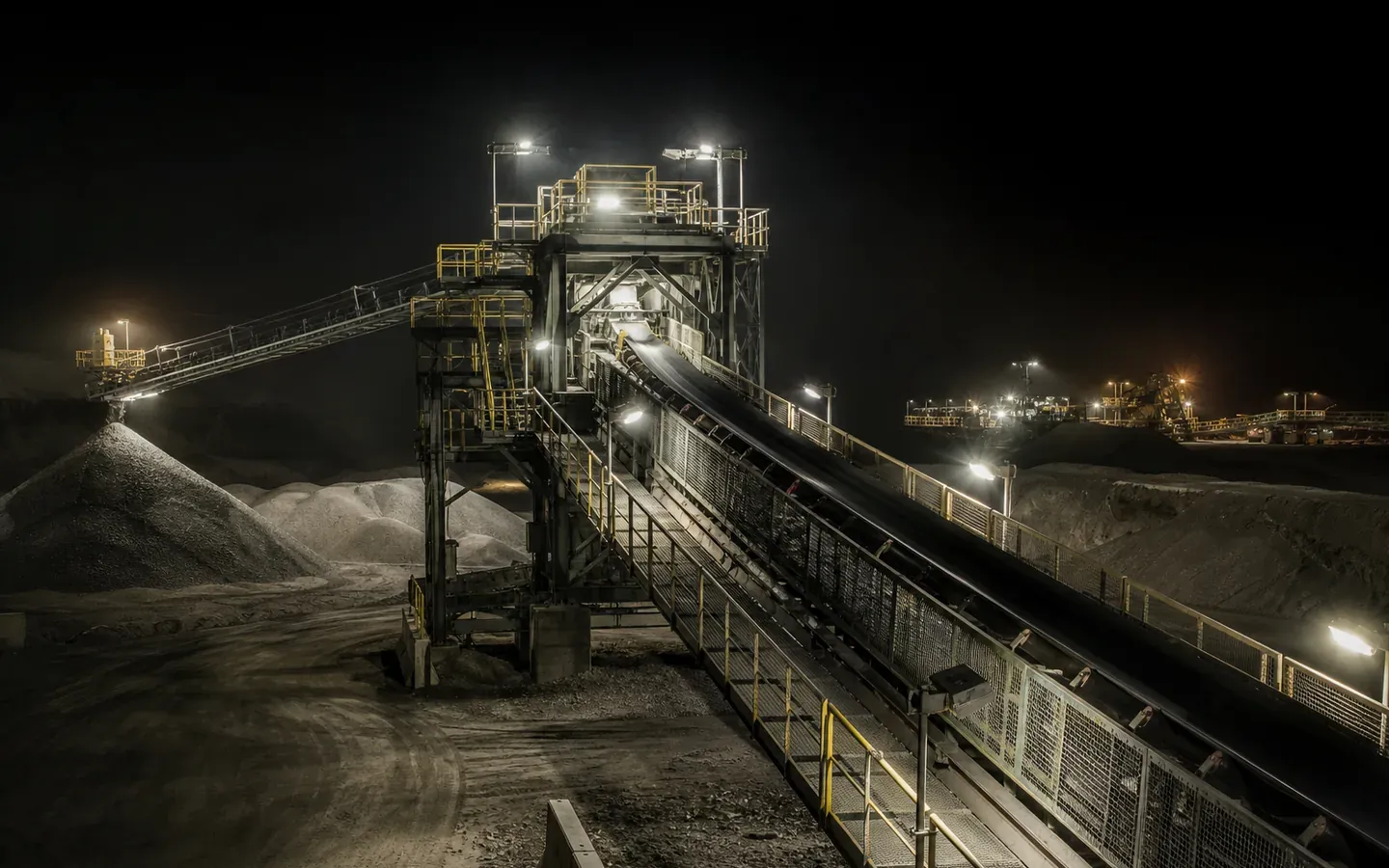
Mining conveyors and stockyards combine dust, vibration, long feeder runs, moving machinery and difficult access. A luminaire selected only by wattage and IP rating can fail mechanically or leave transfer points and walkways poorly visible.
Buyer takeaway: divide the site by task and hazard. Conveyors, transfer houses, crushers, stockpiles and access roads need different optics, mounting and certification evidence.
Map tasks, hazards and maintenance access
Create a schedule for belts, idlers, pull cords, chutes, transfer points, stairs, platforms, stockpile faces and vehicle routes. Define horizontal, vertical and inclined task planes. Operators need to see material flow, blockages and moving components—not only floor lux.
Record whether each location can be isolated safely and reached by platform, lift or rope-access team. Maintenance cost often favors fewer serviceable luminaires with controlled optics over many low-cost fixtures.
Classify dust and explosive risks first
Combustible dust or gas can create hazardous classified locations. The responsible engineer must define the zone/division, material group, temperature class and protection method under the project’s legal framework.
A general industrial high bay or floodlight is not suitable merely because it has a high IP rating. IP addresses ingress under defined tests; it does not equal explosion protection. Request the exact hazardous-location certificate and marking when classification requires it.
Specify dust, water and corrosion exposure
Describe dust type, conductivity, accumulation, cleaning method, water pressure, chemicals and corrosive minerals. Smooth external surfaces and minimized ledges can reduce buildup. Verify cable glands, breathers, gaskets and mounting orientation on the full assembly.
In hot transfer buildings or mills, use the high-temperature high-bay guide to check ambient and thermal data. Do not use a site-wide average temperature for a luminaire mounted above process equipment.
Treat vibration as a complete assembly issue
Vibration can loosen brackets, fasteners, connectors and internal components. Provide measured or engineered vibration exposure where possible. Define locking methods, secondary retention and cable strain relief.
The NEMA C136.31 standard covers vibration withstand and test methods for roadway and area luminaires (NEMA overview). It may inform evidence discussions, but the project engineer must decide whether its test profile represents the mining location.
Select optics for the task geometry
Use narrow or asymmetric distributions for long conveyors and distant stockpile faces; wider optics may suit platforms and transfer areas. Model equipment, handrails and structures that create shadows. Validate every IES/LDT file against the ordered optic.
| Area | Photometric priority | Mechanical priority |
|---|---|---|
| Conveyor walkway | Uniform path and belt-edge visibility | Low-profile protected mounting |
| Transfer point | Vertical light into chutes and equipment | Dust buildup and vibration |
| Stockyard | Long throw and vertical stockpile visibility | Wind, aiming lock and corrosion |
| Crusher house | Shadow control around machinery | Impact, dust and service access |
| Haul route | Driver visibility and glare control | Pole/foundation integrity |
Coordinate long feeders and power quality
Remote structures and outdoor feeders require voltage-drop, earthing and surge review. Specify operating voltage range at the luminaire, not only the transformer. Coordinate upstream and luminaire protection using the surge-protection guide.
For large switched groups, verify inrush current and breaker loading. Staged restart can reduce nuisance trips after an outage if it preserves safe access and emergency functions.
Make maintenance part of the bid comparison
Ask for driver, SPD, optic and gasket replacement procedures. Compare captive hardware, connector access and weight. For outdoor stockyards, a modular LED floodlight may simplify parts replacement if the service method is validated at height.
Retain an approved sample and component codes. Dust-tightness, thermal behavior and certification can be affected by unapproved substitutions.
RFQ clause
“Quote by scheduled mining area and hazard classification. Submit photometric calculations, model-specific files, ambient limits, dust/water/corrosion evidence, vibration method, bracket and retention details, surge/inrush data, hazardous-location certification where required, and service procedures. IP rating alone is not evidence of suitability for a classified location.”
Commission with representative plant equipment operating and record final aiming, control behavior and accessible maintenance routes.